


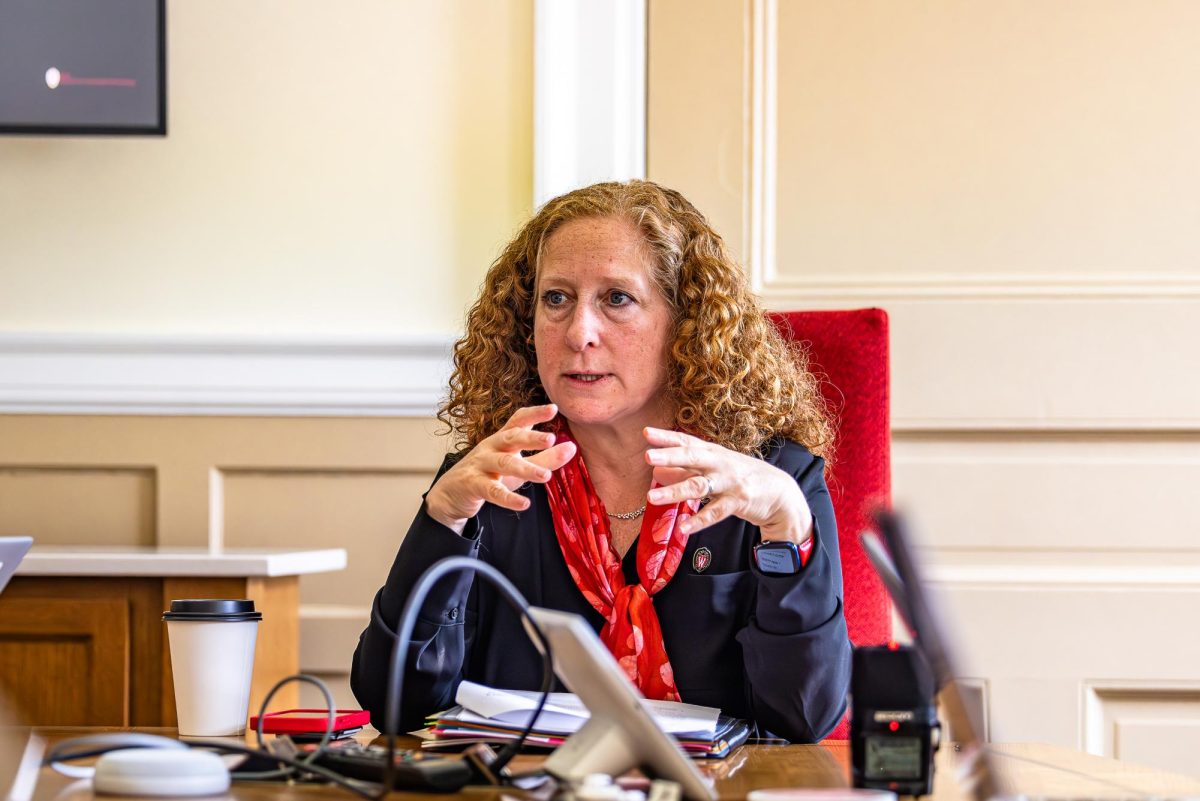

Last month, Chancellor Mnookin announced she will be leaving UW Madison at the end of this year to become Columbia’s President. Current Dean of the College of Letter and Science Eric Wilcots will serve as interim Chancellor until a new Chancellor is selected, likely in 2027, according to the University of Wisconsin.
Mnookin’s legacy at UW is complicated at best, with her work in academics overshadowed by struggles to maintain a campus environment focused on justice and progress.
Mnoonkin made certain positive contributions to the UW community during her time as Chancellor. Bucky’s Pell Pathway is perhaps the most important of her achievements at UW. The program commits UW to meeting full financial aid for four or two years for Wisconsin residents who are federal Pell Grant eligible. She established the Wisconsin Entrepreneurship Hub and the Wisconsin Exchange, two programs focused on leadership prowess and civil debate.
But, her contribution to academics drew controversy through her plans for “the UW-Madison AI trifecta,” or the opening of Morgridge Hall, the Research, Innovation and Scholarly Excellence AI program and the creation of the College of Computing and Artificial Intelligence which some believe will be harmful for humanities programs on campus, according to WPR.
While Mnookin’s academic actions impact her legacy, her mishandling of critical political and community issues remain top of mind for students. Her actions during the encampment, ICE developments, and DEI cuts continue to frustrate students.
The Encampment
For most students, Mnookin’s handling of the pro-Palestine encampment during the spring of 2024 will be emblematic of her time. On the third day of the encampment over 50 police officers from off campus departments — the Madison Police Department, Wisconsin State Patrol and the Dane County Sheriff’s Office — stormed the encampment, bloodying professors and beating students.
A quick survey back to the UW campus in the 1960s would have seen far more extreme forms of protests, like occupying buildings. It should be obvious to Mnookin, from her free speech background, that the encampment was an extremely tame form of protest.
Her actions did not just earn her disrepute with the students, but the faculty and staff of the university as well. The final Faculty Senate meeting of the session saw a raucous group of faculty, staff and students loudly condemning Mnookin. Almost a year after the encampment, the Senate passed a resolution condemning the violence against protesters by a vote of 79-52.
Even after UW reached an agreement with Students for Justice in Palestine, they did not uphold all terms of the agreement in the time since. UW failed to invite a Palestinian scholar to campus each of the past two years, and has withheld the Internal Division’s report on the protest that was supposed to be disclosed by the end of the fall semester in 2024.
Death to DEI
Another instance of how Mnookin failed the student body relates to the dissolution of the Diversity, Equity and Inclusion division. When Mnookin announced the “sunsetting” of campus DEI, the language suggested a beneficial transformation of the division. In truth, the announcement marked a strategic restructuring meant to shy away from national and state attacks. But, for many students, her choice was clear: she opted to stay silent instead of supporting and standing up for marginalized communities.
By dismantling established DEI frameworks rather than publicly strengthening them, she sent a message, intentional or not, that diversity work was negotiable when politically inconvenient.
This lackluster support of students is not exclusive to the second Trump era. Rather, Mnookin’s inaction toward marginalized groups on campus has occurred throughout her administration. For instance, university leadership was criticized by the Blk Pwr Coalition for their unsatisfactory response to a 2023 video of a student spewing racist remarks at Black students.
In her statement, Mnookin said she would address the concerns raised by the Coalition. While immediate action — study accommodations and increased mental health support — may have been provided, the long-lasting tasks have been unfulfilled. The university has not prioritized DEI spending, a zero-tolerance hate-speech disciplinary policy has not been adopted and a specific anti-bias training for all students is still not required. Further, Audrey Godlewski — the perpetrator in the video — received a slap on the wrist after being blatantly racist.
Ultimately, Mnookin’s inadequate treatment of marginalized groups cannot solely be attributed to Trump’s crackdown on DEI. Instead, it stems from her consistent undervaluing of the communities that make this university flourish.
Approach to ICE
The most recent issue students have had with Chancellor Mnookin has been her stance on ICE, or more specifically, her lack of a stance. Considering the violent ICE activity in Minnesota, students are understandably scared for their safety on campus in Wisconsin.
Recently, The Young Democratic Socialists of America at UW confronted the Chancellor in person about her lack of stance on ICE safety on campus. They explained how students deserve to feel safe, demanding sanctuary status.
The YDSA specifically approached Mnookin with requests about legal aid for students facing deportation, labelling of public and private spaces on campus, and utilizing WiscAlerts to inform students of ICE sightings near campus.
As she tends to do, Chancellor Mnookin blamed her lack of a statement on federal regulations, claiming that these requests are not allowed by U.S. law. She expressed concern about what was happening in Minnesota, but overall appears to prioritize legal practice over ensuring student safety.
Students are aware that the Chancellor isn’t in charge of everything that happens on campus, but at this point it appears she doesn’t even consider the wellbeing of students. She even had the gall to tell YDSA that being recorded on the weekend didn’t “feel great.”
The duties of a Chancellor don’t exist on a 9-5 weekday basis. Chancellor Mnookin was, for better or worse, the face of this campus, and what she publicly allows has a serious effect on campus culture.
Silence in the face of inequality as a public figure that represents a diverse college community is nothing short of disappointing. But what’s even more disappointing is that it was entirely expected.
Looking Forward
So, to create a fresh, positive campus environment, Interim Chancellor Eric Wilcots and our future full time Chancellor must take clear stances on the issues important to students and work to foster not only a commitment to academics, but also a sense of social responsibility. As the leader of UW’s flagship institution, our Chancellor sets an important precedent for the UW system.
Interim Chancellor Wilcots is a welcome fresh perspective. Wilcots continues to place emphasis on the importance of DEI in his role as Dean of the College of Letters and Science. As the first African American Dean of L&S, he is aware of the impact of representation and strives to be a role model for all.
Understanding and responding to student priorities should be our Chancellor’s focus. Students want clear policies and plans for defending DEI, funding and protesting on campus in a time when these values are not shared by the national government. They want to feel free to express themselves on campus without fear of retaliation.
Ultimately, we believe an adaptable, future and community focused leader is the Chancellor UW needs to meet the current political and academic moment.

