

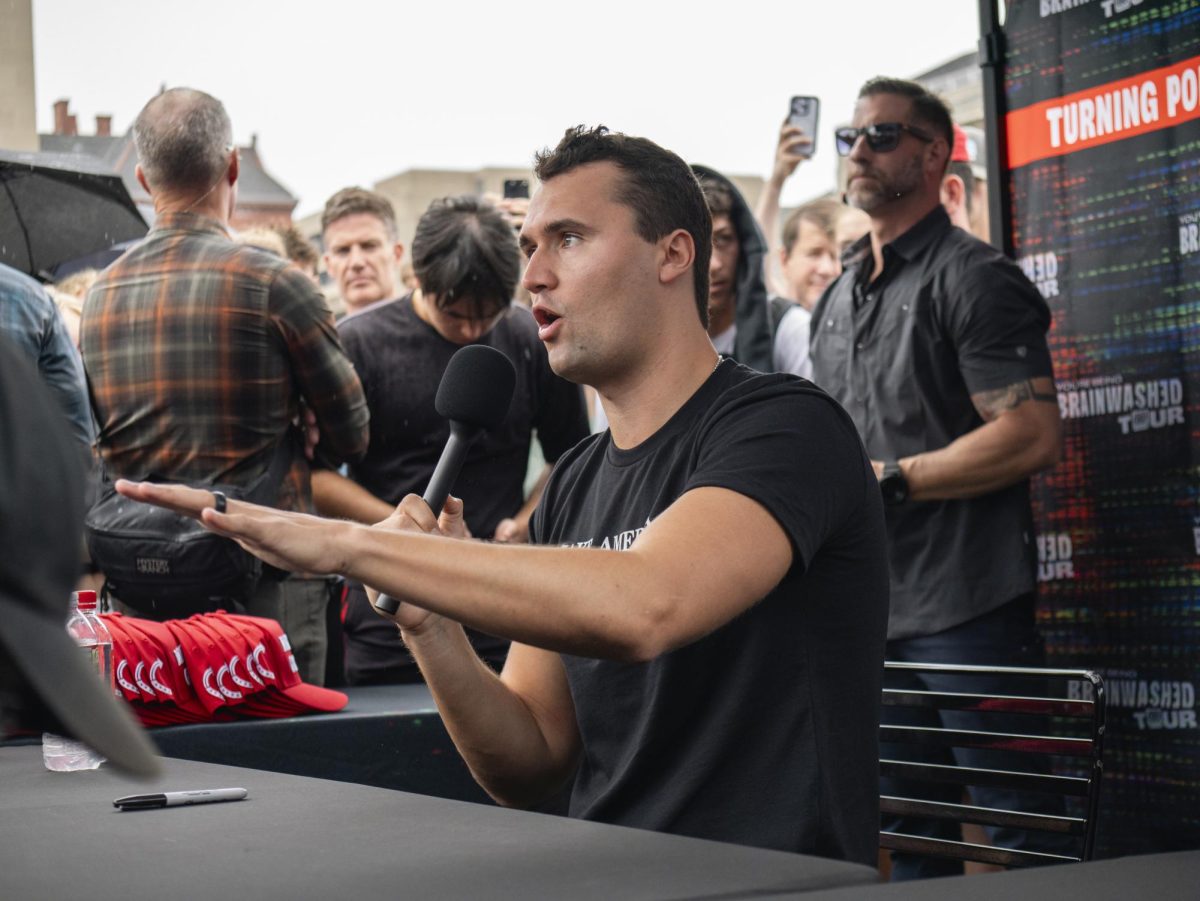

Republican-led states across the country are helping Turning Point USA expand its reach into high schools. The conservative organization was founded by Charlie Kirk and aimed to promote conservatism within youth and inspire right-leaning advocacy on college campuses and in higher education. Turning Point USA also has 3,200 chapters in high schools, student-lead clubs called Club America, according to The New York Times.
A recent partnership between Turning Point and state governments has sprung in Arkansas, and expectedly Indiana as well, according to The New York Times. Similar plans are also established in other conservative states.
While youth have always been the primary audience of Turning Point, the expansion into high schools is a more recent topic following the assassination of Charlie Kirk, one of Turning Point’s founders. Considered an idol for many conservative youth, Kirk aimed to build a conservative campus movement.
In the weeks before his death, Kirk had sent out emails to Turning Point’s senior director, Josh Thifault, that he hoped to start 20,000 Club America Chapters in high schools, according to The New York Times. Since his death, Turning Point has added 2,000 new chapters.
Club America advertises itself as an organization leading the youth movement for freedom-loving American values, encouraging students to engage in grassroots activism, according to Club America. Due to its tie to the radically far-right Turning Point USA, some liberals are afraid the club is an example of conservative indoctrination.
Starting a chapter of Club America is completely student-led. Despite the said partnership between state governments, there will be no mandate or forced establishment in high schools. Federal law requires equal access to all student organizations. Essentially, schools must approve the establishment of all student organizations regardless of religions, political or other content, unless any content is disruptive, according to the Legal Information Institute. What counts as disruptive is subjective, making the debates about establishing Club America chapters incredibly open-ended.
Regardless of the political content the organization relays to students, state involvement is skeptical. States are putting pressure on teachers and administrators to either advocate for establishment or approve of doing so.
Public schools are meant to be spaces for students to develop their own ideas and state-backed promotion of politically affiliated organizations creates an uneven playing field. The partnership with Club America reads like coercion and can feel more like indoctrination rather than education. States should keep their power and influence away from student organizations to allow schools to be a place for diverse perspectives.
It should be noted that denying the establishment of political clubs, such as Club America, creates one-party dialogue and eliminates the rich discourse that stems from disagreement. Schools should be equitable environments that do not silence viewpoints but help students learn how to respect one another’s ideological differences.
Students have the opportunity to participate in political conversations without fear in school because classroom communities are designed around the norms of inclusivity and respect. Schools are supposed to be safe spaces for all students regardless of political ideology. This safety net does not exist in the real world — in these spaces, students should have the opportunity to disagree and learn from others that are different from them so they can practice navigating conversations.
But the concern is in Club America chapters becoming a diverse force in schools. Popular patriotic values oftentimes are more than just American pride. Schools could quickly shift from inclusive to alienating, targeting marginalized students and creating hostility amongst the student body.
While Club America seems non-partisan in its advertisement, its relationship to Turning Point USA leads to another idea. Turning point’s rhetoric is racist and homophobic, known for promoting ideas that marginalize LGBTQ+ individuals and people of color. It invokes white Christian supremacy with a strategy of exploiting the fear that republican politics are under attack.
The separation of church and state blur in Turning Point’s beliefs as the organization promotes Christian nationalism. Turning Point USA and Club America are rooted in the idea that some identities and beliefs are more “American” than others. These identities and beliefs are white and Christian.
These are not values that are inclusive to all students. They are representative of merely a portion of youth today. These are values that would frankly not just exclude, but possibly endanger many students. For students whose identities are already marginalized, school would shift from being that safe space to a place where they are targeted, unwelcomed or could feel unsafe.
As the widespread establishment of Club America is discussed, the argument does not get any easier to comb through. All students should have the opportunity to express their political beliefs. If they do not, that is to say that some perspectives are more valuable than others.
But at what point do we label the organization’s content as disruptive and harmful? When states promote a political organization, when do we call it indoctrination? At the core of this issue lies the tension between protecting open expression and maintaining inclusive, safe environments for all students.

