



While widespread Immigrations and Customs Enforcement activity has not been reported in Wisconsin, increased activity around the country requires nonprofit groups and government officials to call for preparations. But, preparations would be more effective if leadership in the state had a more unified goal.
Darryl Morin is the national leader of Forward Latino, a national nonprofit organization based in Milwaukee that provides resources for those impacted by ICE activity. He said in an email to supporters that there is general consensus among community organization leaders that ICE activity will ramp up in Wisconsin in the coming months, according to Wisconsin Watch.
Wisconsin would face unique challenges if ICE presence increased. Immigrant communities who play a crucial role in Wisconsin’s agriculture sector may have less access to resources and less media attention than larger cities if ICE begins to operate in rural areas of the state, according to The Cap Times.
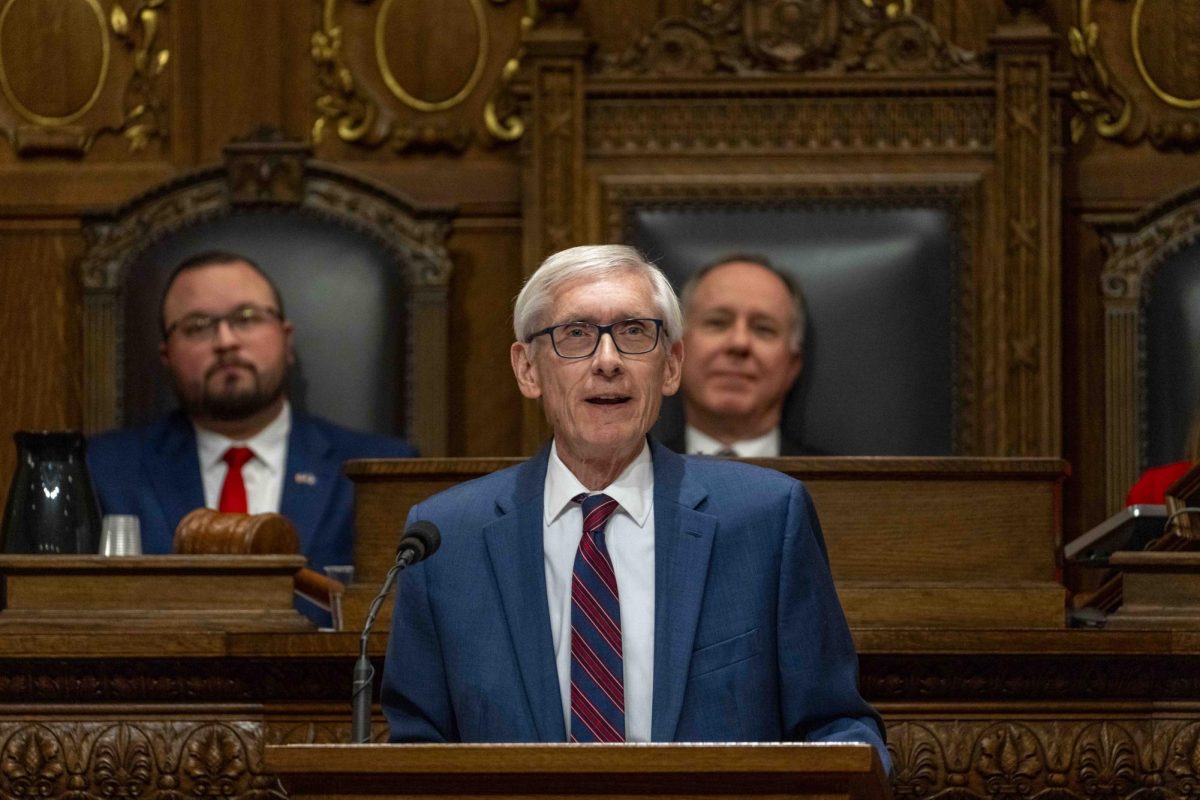
State leaders are prepared to take action if ICE activity in Wisconsin increases. Gov. Tony Evers remains in communication with nonprofit leaders across the state to discuss preparations for immigrant communities, according to The Cap Times.
Evers talks with Minnesota Gov. Tim Walz frequently, according to The Cap Times. While Walz has not requested aid from Wisconsin, Evers was open to supporting Minnesota if necessary.
Evers also focused on staying in contact with tribal leadership as the Native American population may become a target of ICE activity. Reports of tribal members being detained in Minnesota and South Dakota due to ICE not accepting tribal IDs as a valid proof of citizenship presents potential for this to be a focal point in Wisconsin, according to The Cap Times.
While Evers pointed to each of these potential moments where ICE activity could present unprecedented challenges in Wisconsin, he did not provide a clear plan for Wisconsin government leaders to follow.
Wisconsin candidate for Gov. Sara Rodriguez introduced a plan to restrict ICE entrance into spaces such as hospitals, schools and churches without a judicial warrant. Evers declined to outwardly support this plan, and he cast doubt on its ability to pass the Republican controlled state legislature, according to The Cap Times.
He also commented that the plan could cause retaliation from the Trump administration. Evers warned this could cause ICE action to rapidly increase in Wisconsin, according to The Cap Times.
Evers’ lack of commitment to legislative action against ICE is frustrating because Wisconsin must act now to prevent widespread ICE action and violence similar to the continuing conflict in Minnesota. Even if the proposed bill did not pass through the legislature, taking action now would signal that lawmakers are prepared to challenge ICE action.
Fear of retaliation should not be a reason to avoid taking action against the federal government. ICE and the Trump administration succeed through instilling fear in the population, so state level leaders must be a counter force.
State level lawmakers should take the opportunity to make ICE access more difficult in Wisconsin before a large scale ICE operation reaches Wisconsin. Because the lawmaking process takes time and will inevitably face opposition, this action must start now.
Leaders around the country are not unified on a message nor a plan for how to counter the federal government’s actions.
Lawmakers in other states also face difficulties passing laws to restrict ICE. New Jersey state lawmakers passed a series of bills through the legislature aimed at restricting local law enforcement compliance with ICE and ending “racially influenced policing” in the state, according to the New Jersey Monitor.
Gov. Phil Murphy used a pocket veto to avoid signing the bill during his last few days in office, citing potential legal challenges to the bills. Legislators expressed widespread frustration as many felt legislative action was the most concrete method of challenging the federal agency, according to the New Jersey Monitor.
In California, the state legislature will consider a bill aimed at allowing residents to sue ICE officials for constitutional violations. Some say this will have unintended consequences on local law enforcement, according to the LA Times.
Bills introduced in other states such as New York and Georgia had varying levels of success.
While these bills are a step toward restricting ICE, their larger impact comes in what the bills do not achieve. The lack of unity in message and goals among Democratic leadership around the country creates greater uncertainty and fear in local communities.
National Democratic leadership must create a comprehensive plan for how they will counter the Trump administration’s actions as the administration is only increasing its reach. State level leadership will then be able to adapt the plans to specific situations within a state.
On the national level, the House of Representatives passed the Fiscal Year 2026 Department of Homeland Security Funding Bill Jan. 22. The bill included $370 and $400 million in increased funding for enforcement and detention, respectively. The bill does not include any checks on the agency’s power, according to the National Immigration Law Center.
The increase in funding combined with the lack of unified Democratic response will prove dangerous for immigrant communities around the country.
Democratic leaders in Wisconsin must not accept ICE activity as a new reality in the state. Leaders must not allow fear of repercussions from Trump to weaken their fight to restrict ICE activity, as failing to act now will have dangerous implications for immigrants in Wisconsin.
