


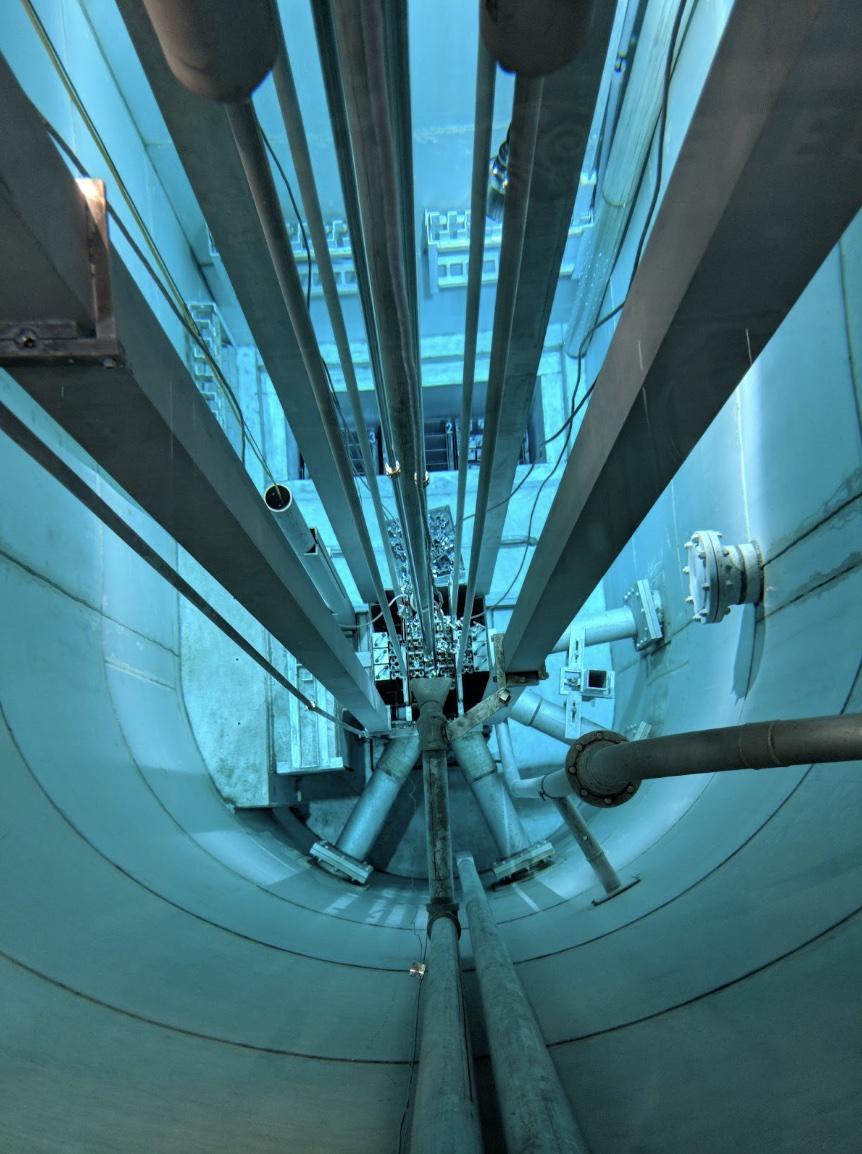

Outside of those in the Department of Nuclear Engineering & Engineering Physics within the College of Engineering, few know that the University of Wisconsin is home to a one-megawatt TRIGA research reactor, referred to as the University of Wisconsin Nuclear Reactor or UWNR.
The UWNR is located in the Mechanical Engineering building and obtained critical status in 1961, meaning the reactor can maintain a steady chain reaction, Paul Wilson — the Grainger professor of nuclear engineering and Chair of the Department of Nuclear Engineering & Engineering Physics — said. The UWNR is one of twenty five university research reactors across the U.S., which is a rarity among universities, senior nuclear engineering student and licensed student operator of the UWNR Gerson Esquivel Garcia said. But, the reactor is approximately 1/3000th of the size of a traditional commercial reactor.
“It’s a really nice feature that, slowly, we are getting more to get to know about it,” Garcia said.
The UWNR has three main missions: instruction, research and industry support, according to Wilson. Within the instruction mission, the UWNR is used in nuclear engineering curriculum as a first-year course to learn all the basics of reactor operation, a senior lab course to understand the physics of how reactors work and an elective course for students to become trained licensed operators of the reactor, according to Wilson.
Under the research mission, the reactor’s priority is to provide neutrons for radiation to understand how different materials, systems and components respond to the radiation, Wilson said. Currently, CNERG or Computational Nuclear Engineering Research Group, which is led by Wilson, is collaborating with the Idaho National Laboratory to analyze nuclear systems and understand how samples of new materials become radioactive when exposed to neutrons, Wilson said.
To fulfill the industry support mission, the UWNR has worked with multiple medical isotope companies to assist in developing viable medical products. Additionally, the UWNR has served as a location for various companies within the industry to test new nuclear reactor technology under exposure to radiation, Wilson said.
One reason UW acquired the UWNR in the first place was due to Max Carbon, an enthusiastic pioneer of nuclear engineering who founded the nuclear engineering program at UW and played a key role in finding support and funding for the UWNR, Wilson said. When the reactor was first licensed in the 1960s, there was plenty of research and learning to be conducted about nuclear reactors — UW was a notable place for preliminary questions about nuclear energy, according to Wilson.
“How did nuclear reactors actually work? How do we control them? How can we predict what’s going to happen under different circumstances?” Wilson said.
For students in the nuclear engineering program, the UWNR creates an opportunity to assist in obtaining a job following graduation, as it offers experience in an environment similar to a nuclear power plant. This allows students to perform tasks such as starting up or shutting down the reactor or reading instrumentation, according to Wilson. In Garcia’s day-to-day work at the reactor, some days focus on operating the reactor, running various tests or projects or even giving tours, while other days are spent doing routine maintenance with ventilation, air and water in the facility.
Garcia was chosen as a student operator for the UWNR following completion of a first-year course when his professor announced that the reactor was hiring students. After submitting application materials and participating in an interview, Garcia was selected as a trainee, where he spent an additional semester learning intricate operations and working with other trainees. Following passing the Nuclear Regulatory Commission licensing exam, Garcia became a licensed reactor operator.
“[Being licensed] is definitely impressive. There’s not that many people in the nuclear field that get to actually work with a reactor,” Garcia said.
There have been two main takeaways to student involvement with the reactor, according to Garcia. First, the technical aspect of the job and gaining experience writing procedures has helped to develop a safety culture, detail orientation and work ethic, Garcia said.
Additionally, outreach to different companies, schools or age groups have created a sense of technical communication when explaining complex concepts in a simple way to different audiences, Garcia said.
“It’s not only just working and learning how neutrons interact with the uranium, but also just being able to explain and show people that it’s a safe technology that we’re working towards,” Garcia said.
While there are no imminent plans for any changes to the reactor, the reactor has the potential to adapt to research opportunities or changing technology. The UWNR attracts many researchers, and if a potential project requires an upgrade to the reactor, new equipment driven by eager researchers could be a possibility, according to Wilson. Further, as commercial power reactors phase out of non-computer analog control systems into newer digital operations, the UWNR may face upgrades to continue supporting student success and exposing them to reactor technology they will encounter in the workforce, Wilson said.
