


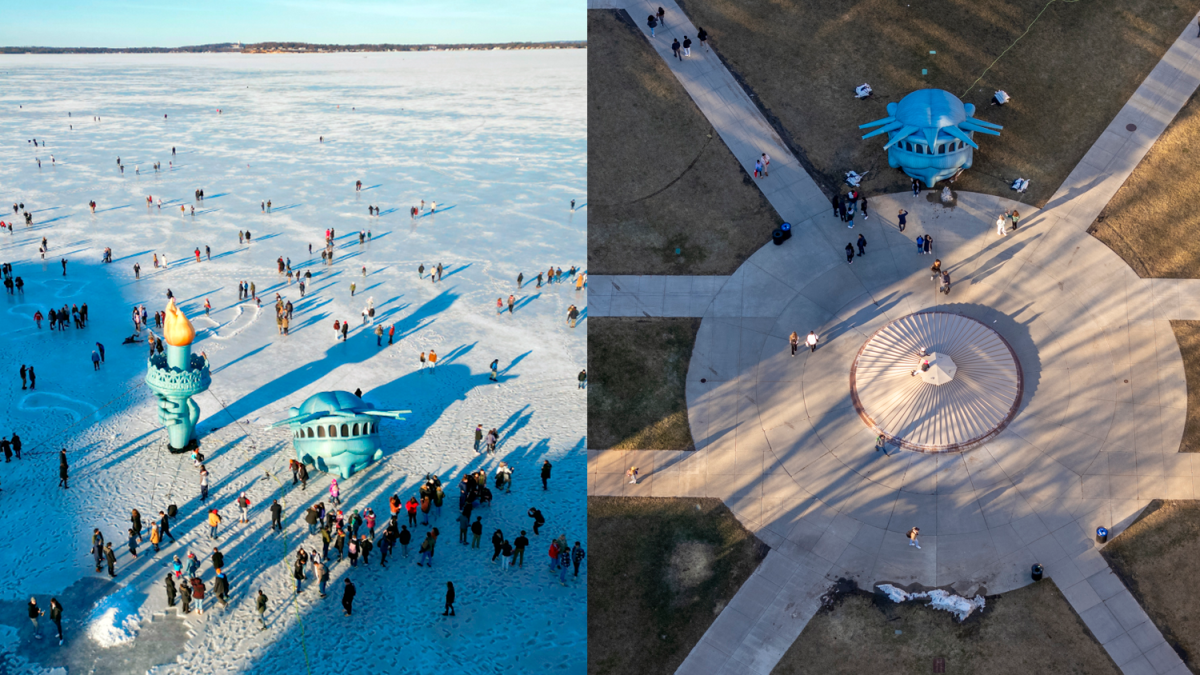

As global warming and climate change persist, the melting of ice in lakes poses severe and misunderstood threats to ecosystems and the economy. Ice loss from lakes that freeze over in the winter impacts societal traditions and economic activity, according to a study by Science.
Climate change is often confused with weather — weather is a change in atmospheric conditions, while climate change refers to the weather over a long period of time. Since 1850, Earth’s surface temperature has risen by 0.06 degrees Fahrenheit each year, according to the National Oceanic and Atmospheric Administration.
As Earth heats up, glaciers and ice sheets are slowly disappearing. Climate change is causing extreme changes in ice cover levels — the rate of ice loss has steadily increased over the past 25 years, according to Science. Recent models project ice loss to increase exponentially as 80% of lakes at lower latitudes are vulnerable to not being utilized for human activities.
If this continues, water levels on Lakes Mendota and Monona will increase, causing eventual flooding which could prevent the University of Wisconsin’s most treasured traditions from happening, according to the Milwaukee Journal Sentinel.
Olaf Jensen, a professor in limnology at the Center for Limnology, provides some insight into the past, present and future of ice loss in lakes. His research consists of studying ice loss across the Great Lakes region.
Jensen said the main drivers of ice loss in lakes are the date in which a lake freezes, the depth of a lake and climate change.
The date that a lake freeze varies for each lake. Jensen said a lake’s density has to change before the lake has the ability to freeze over and how lake thawing is primarily driven by temperature. Lakes have higher densities at higher temperatures and lower densities at cooler temperatures, meaning there would have to be some sort of stark change for this process to proceed.
Lakes are home to various species of fish and other organisms. When patterns in the date of ice freezing shift significantly or when ice’s inability to freeze over occurs, ecosystems are disrupted, Jensen said.
“Winter is an important time for reproduction for fish,” Jensen said. “Because the timing of ice freezing over is changing, there’s a mismatch in when fish eggs hatch and when plankton, a main source of food for fish, is available to them.”
Since the time in which ice freezes over completely is unpredictable, the existing food chain is altered.
Zach Feiner, a scientist at CFL, studies the effects of ice freezing over on ecosystems.
“This unpredictability sets off a cascade of events in the lake’s food web – algae bloom, zooplankton eat the algae, and young fish eat the zooplankton,” Feiner said. “Weird ice off timing can mix up this cascade, leaving young fish with little to eat, and they don’t survive as well.”
Plankton can reproduce at a quicker rate in warmer water, so less plankton is available in the winter months. As fish begin to hatch earlier, there becomes a shortage of food supply. This makes it more difficult for newborn fish to have a source of food, and survival rates of newborn fish decrease dramatically.
Lakes Mendota and Monona are home to various species of fish and one of Wisconsin’s most popular attractions is fishing.
“The most popular fish in Lakes Mendota and Monona is Bluegill,” Jensen said. “Bluegill are targets of fisheries and actually stand to gain from climate change in the short-term, while walleye, another popular fish, is negatively affected.”
Bluegill prefer warm water and are often a target of Wisconsin’s ice fishing industry as they are abundant and have high protein and omega-3 fatty acid content. Walleye thrive in cooler water temperatures. Walleye are often consumed by humans as they are a good source of vitamins. Warmer bodies of water are highly unfavorable for walleye as they are biologically adapted to survive in lower temperatures.
Another fish that is commonly found in Lake Mendota is cisco — also known as lake herring. Cisco thrive in cool waters and are most abundant in the fall months. Climate change has devastating effects on the cisco population.
“Cisco spawn in shallow areas in the fall, and having ice cover is really important for stabilizing those environments while eggs incubate,” Feiner said. “Without ice, they’re susceptible to wind, storms and waves dislodging and smothering eggs.”
Without ice sheets, cisco’s reproduction is limited, altering the food web. As waters become warmer, the waters become uninhabitable for cisco as they are biologically adapted to survive in cooler waters, Feiner said. Similar to walleye, cisco are also driven out as the water temperature begins to rise, permanently changing the ecosystem.
The time in which ice freezes over affects biodiversity in both Lake Mendota and Lake Monona. As lake water continues to get warmer, many species of fish that are biologically adapted to survive at cooler temperatures migrate elsewhere.
“We often lose native cold water species that are adapted to colder conditions that used to be here. In-turn, we gain invasive warm water species,” Jensen said. “This is referred to as ‘biotic homogenization,’ meaning cold water lakes stop being as unique as they used to be.”
Invasive species pose a serious threat to native ecosystems in Lakes Mendota and Lake Monona by altering the food web and depleting resources that are necessary for the survival of native species.
The time in which ice freezes over also impacts the economy. UW’s campus sits between two lakes, which serve as the epicenter of some of the university’s most popular events. Ice loss takes away from economic activity during the winter months.
Both lakes boast ice fishing opportunities for civilians during the winter months. Ice sheets over both lakes are not anticipated to freeze until late January, limiting all ice fishing, ice skating or ice boating activities that can go on. Jensen said 2023 was a terrible year for the ice fishing industry.
“There were only a couple of weeks that were safe to go out onto the ice,” Jensen said. “We are no longer a place that has enough ice for a robust ice fishing season.”
Lakes north of Madison still have enough ice that it is safe for humans to traverse the ice.
Many UW students look forward to Lily’s Classic, which is an event hosted by Interfraternity Council chapter Sigma Alpha Epsilon. It has been a tradition for decades as it is one of the largest fundraising endeavors supported by any Greek organization on campus. This event is an annual hockey tournament played on Lake Mendota in support of Lily’s Classic funds, which supports Epilepsy research.
Lily’s classic was ultimately canceled last year as Lake Mendota could not freeze over and support the weight of all players and spectators. If patterns continue, the beloved event is unlikely to continue.
If conditions persist, native ecosystems and UW traditions will continue to bear the burden.
