


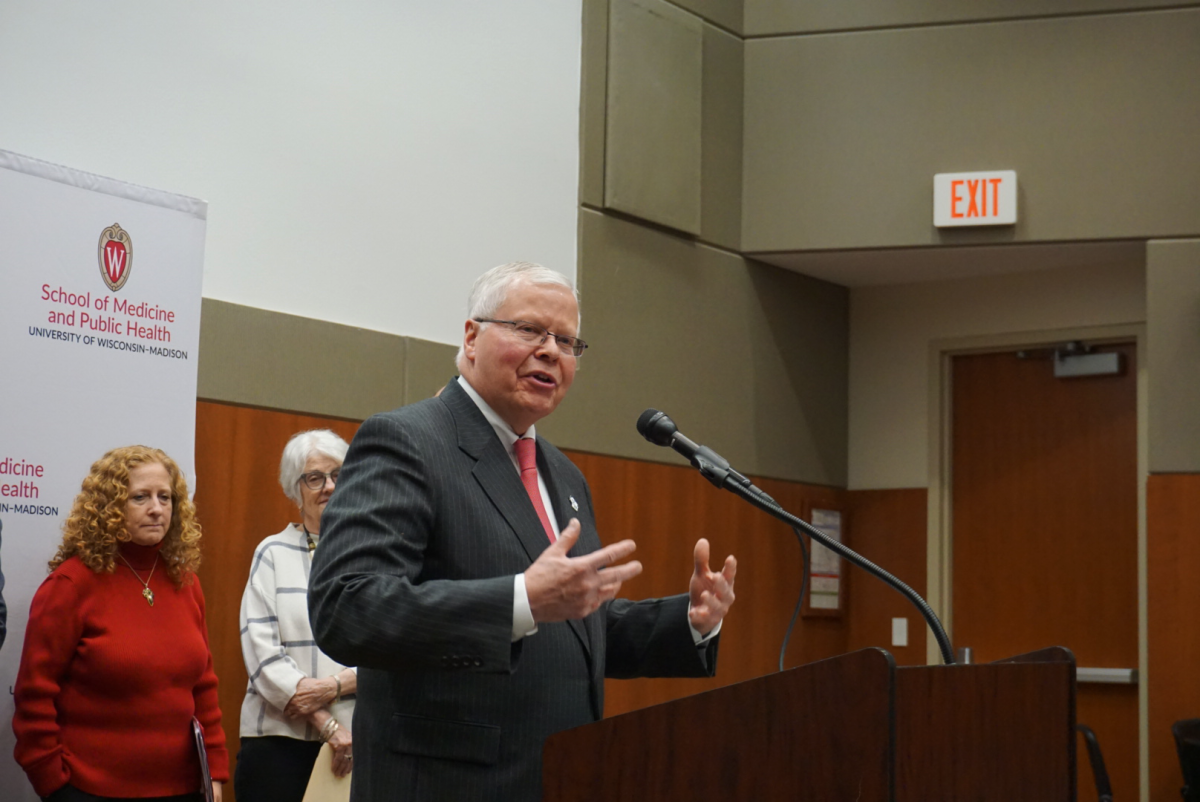

Univerisities of Wisconsin President Jay Rothman sees artificial intelligence less as an ambiguous idea, but rather a transformative tool in how Wisconsin’s public universities should work, according to the op-ed written by Rothman.
According to the op-ed, Rothman will explain his approach to artificial intelligence implementation within forms of higher education before the Board of Regents meeting this Thursday.
Rothman also understands that while AI has its benefits, there are potential downsides that must be acknowledged as well, according to the op-ed.
While the challenges with future AI usage in higher education have been recognized, questions arise regarding the educational, social and ethical concerns of AI implementation across the 13 UWs, while ensuring academic quality and integrity, as stated in the op-ed.
Rothman said that this focus on AI is to “prepare students for the future” and provide appropriate “AI literacy,” while maintaining students’ skills regarding critical thinking and problem solving, according to the op-ed.
While Rothman stresses the importance of building AI literacy skills for students’ future careers, UW-Madison Life Sciences Communication Professor Dietram Scheufele said that AI integration should be done carefully.
“We need to balance the idea of using these tools and prepare students for a world where using these tools would not be optional within each profession,” Scheufele said.
Scheufele used the analogy of flying an airplane when comparing the positive and negative aspects of AI usage in higher education.
This analogy emphasizes that AI is neither inherently good nor bad, but dependent on how it is used, Scheufele said.
“A parallel is how airplanes have developed and now there are tons of computer systems,” Scheufele said. “And, no, you don’t manually pull the lever to get the plane to take off. A computer does that. But do you still have the skills when all of those computers fail to do it yourself?”
Rotham and UW experts agree that AI’s role in higher education is unavoidable. The focus should be on embracing, not resisting new technologies like these, while still ensuring that students develop fundamental skills, crucial to enter the workforce, Scheufele said.
