


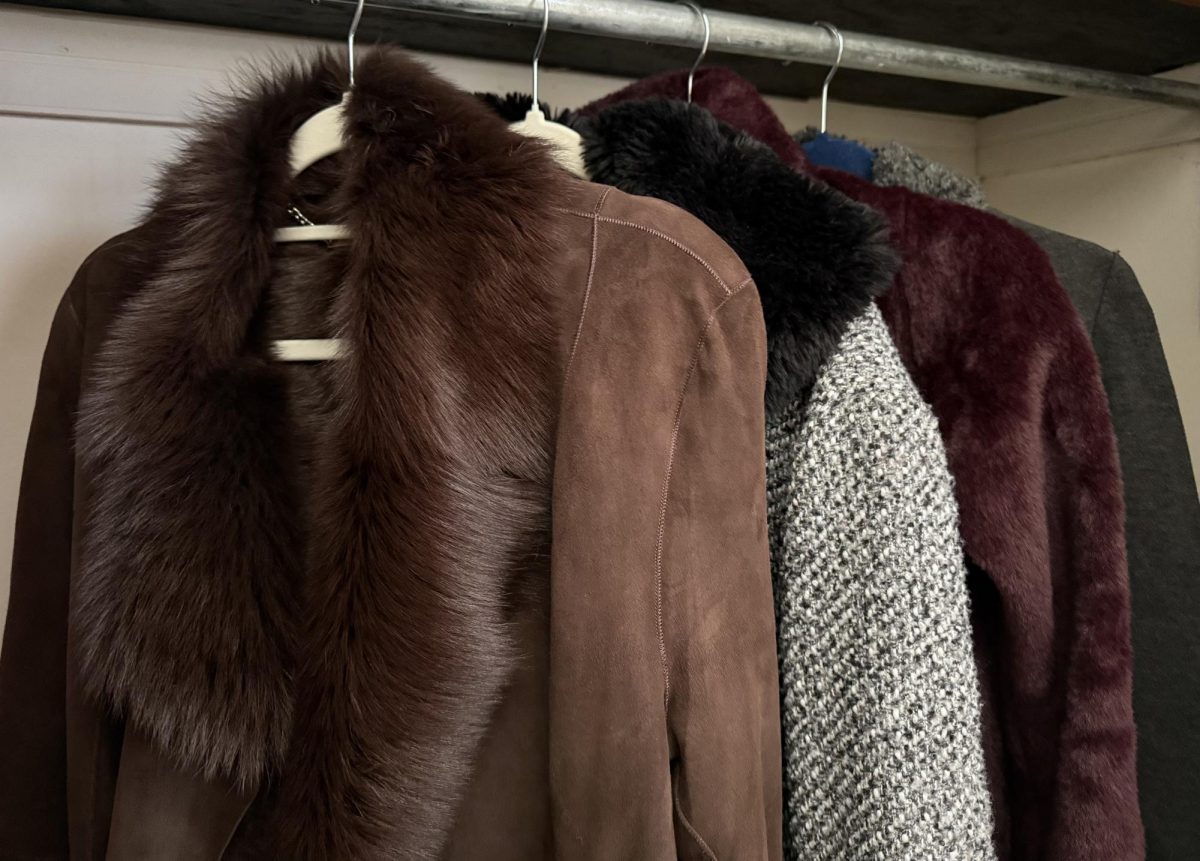

Like a red lip or a good pair of blue jeans, fur doesn’t go out of style.
I imagine that the women who regularly wear it — and I’m talking real fur, not the cheap plastic faux stuff — are the type to greet their friends with a kiss on each cheek, drink red wine with dinner and smoke long white cigarettes. When it’s cold enough, they can disappear within their big fur coats, and all that can be seen of them are their glossy black high heels poking out from the bottom of their thick brown pelts.
Chic as fur may be, its continued production is one of the most contentious issues in fashion today. In a 2025 survey of adults living in the northeastern region of the U.S., 60.7% of respondents agreed that fur farming is cruel to animals, indicating a generally negative public sentiment toward fur — and presenting the fur-curious with a bit of an ethical dilemma.
To begin with, to afford a quality fur coat, the average American would need to take out a loan or attempt an “Ocean’s Eleven”-level shoplifting coup at their local department store. And if that loan is approved — or if that heist is successful — they’d still face the scorn of approximately 60.7% of their peers who find wearing fur to be morally reprehensible.
All this begs the question: is there any ethical way to wear fur?
The answer? It’s complicated.
Real fur, real consequences
Fur clothing might not be as popular in Madison as it is in bigger cities like Paris and New York, but fur has played a significant role in Wisconsin’s history.
The first European settlers to come to the state en masse were French fur traders in the mid-17th century. At the time, beaver-skin hats were quite à la mode in France and the rest of Europe, and there was no shortage of beavers here in Wisconsin — that is, until the mid-19th century, when overhunting drove the creatures to the brink of extinction and brought the Badger State’s fur-trading era to a close.
Today, most Wisconsinites choose to don winter coats made of nylon and polyester rather than stitched-together beaver skins, and in general, fur is seldom sourced from wild-caught animals anymore: According to the aforementioned 2025 study, 95% of fur comes from animals bred, confined and killed on commercial fur farms.
Fur farming usually involves lifelong confinement of animals and inhumane killing methods, so it’s no surprise that the industry is denounced by animal rights activists in groups like PETA and Fur Free Alliance. While it’s actually an urban myth that these activists like to throw paint on fur-clad passersby, they’ve found other ways to effectively campaign against fur farming for decades.
This activism, along with shifting public opinion on fur, has resulted in a fur industry that’s in steady decline. According to the Fur Free Alliance, in 2003, the United Kingdom became the first country to end fur farming for good, followed by Austria in 2005. Since then, more than 30 countries have banned fur farming or introduced stricter regulations on their fur farming industries. Here in the U.S., fur sale bans have taken effect in cities like Lexington, Mass., Ann Arbor, Mich. and Boulder, Colo., as well as in the state of California.
Designer labels have taken stands against fur, too. In 2018, Burberry announced it would ban rabbit, fox, mink, angora and Asiatic raccoon fur, and Coach phased out real fur beginning in 2019, although it still uses leather and shearling. Other high-profile labels like Chanel, Versace and Gucci have phased out fur, too, suggesting that maybe, fur can — and will — go out of style.
An animal-friendly alternative?
Perhaps wearing fur doesn’t have to come with a guilty conscience. Not only is imitation fur aesthetically similar to the real thing, but it’s animal-friendly, and there’s lots of it to go around. As early as late summer, popular clothing brands begin peddling faux fur coats, shawls, blankets and vests in anticipation of fur coming back en vogue every winter.
The prices of these faux fur garments are certainly more attractive than those of real fur. A faux fur coat from SHEIN, for example, typically goes for less than $50.
But if the prices of faux fur garments seem too good to be true, it’s because they are. Faux fur is cheaper because it’s made of synthetic materials like polyester, nylon and acrylic, which take 30-200 years to decompose — not to mention that they’re far less insulating than the coat of an animal that’s literally been optimized over centuries of evolution to keep mammals warm.
Most of the time, faux fur garments are nothing more than landfill fodder that are sure to become threadbare after three wears — tops.
What’s the fur-dict?
Is it so bad to, in the age of microtrends and fast fashion, yearn for clothing that’s actually made to last and never goes out of style, like fur?
The answer is no, and you don’t even need to sacrifice your morals to satisfy that hunger for high-quality vêtements. Find a moral middle ground (and avoid lifelong credit card debt) by purchasing secondhand fur from vintage stores. You’ll find that the only thing that beats the shopper’s high of buying a brand-new fur coat or hat is the warm and fuzzy feeling that only a clean conscience can give you.
