


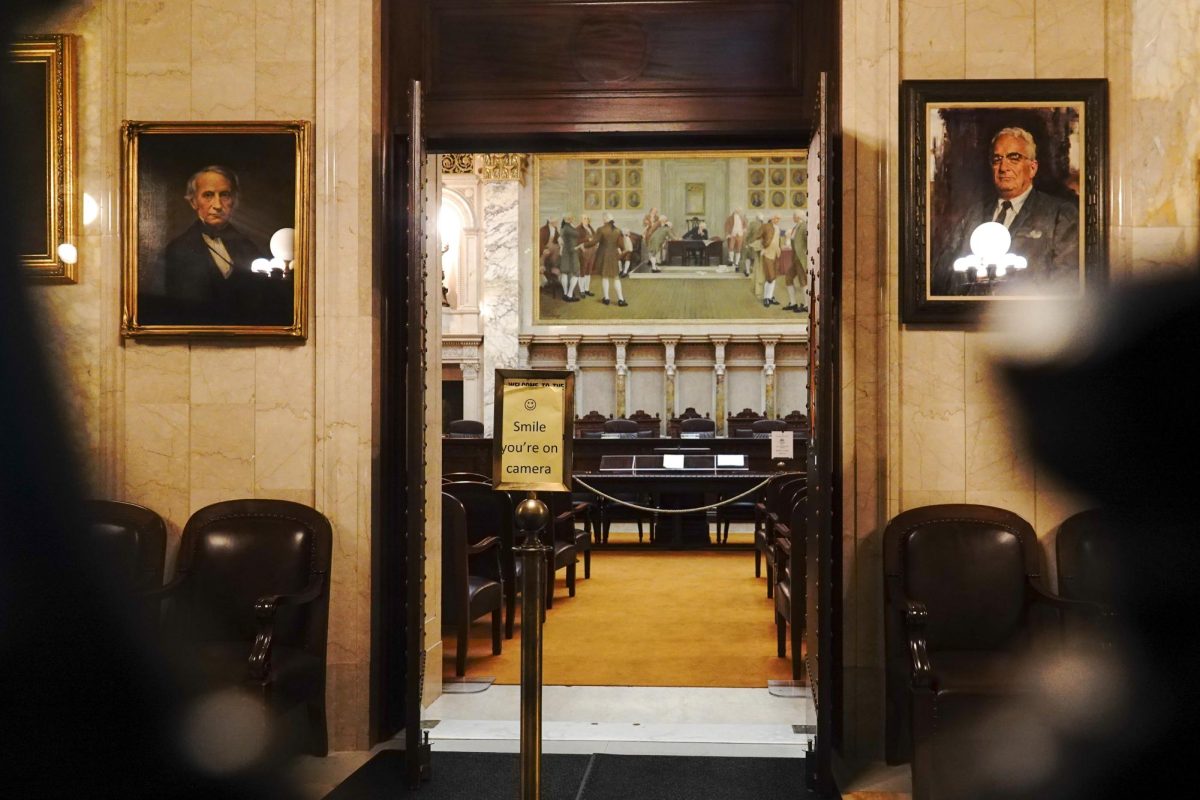

Law Forward, a non-profit organization, filed a brief on Oct. 9, following Wisconsin Business Leaders for Democracy and individual voters’ challenge to Wisconsin’s congressional map as an unconstitutional anti-competitive gerrymander this past June.
Law Forward’s brief, on behalf of voters and WBLD, requested a three-judge panel for the case on gerrymandering from the Wisconsin Supreme Court.
According to president of plaintiff WBLD John Florsheim, the current district lines are drawn in an anti-competitive way. Wisconsin is a purple state, however, the congressional maps do not reflect the relatively even distribution of democrats and republicans, as they tend to represent the state at 75% republican, according to Florsheim.
“What we’re trying to do is have the maps redrawn in a competitive way in Wisconsin so that they’re free and fair,” Florsheim said. “If you look at the Wisconsin congressional maps, seven of the eight districts are decided by 30 points or more,” he said.
In 2011, Wisconsin congressional maps were reapportioned following the 2010 census by democratic and republican officials, according to Florsheim. This is the first case of challenging congressional districts on the basis of anti-competitive gerrymandering in Wisconsin and one of the few in the country, Florsheim said.
Anti-competitive gerrymander differs from partisan gerrymander as it suppresses electoral competition, as opposed to favoring a particular party, according to staff attorney with the State Democracy Research Initiative at the UW Law School Bryna Godar.
“It benefits incumbents and gives voters less of a say in the election,” Godar said. “You see this happen where you have districts that are not particularly competitive compared to what you would have under a neutral map.”
The particular state statute that plaintiffs are requesting requires the Wisconsin Supreme Court to appoint three circuit court judges to hear the case for reapportionment, according to Godar. This panel process was invoked for the reapportionment in 2011, but the case was dismissed and the three judge procedure was not enacted, according to Godar.
Godar says the argument is these types of cases warrant additional judges and the process resembles what is used for federal court cases of redistricting.
“We want districts that represent the true will of the voters,” Florsheim said. “Voters should be able to pick their elected officials–elected officials shouldn’t be able to pick their voters.”

