


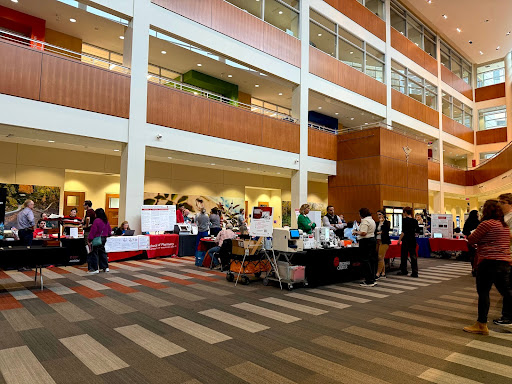

The UW Carbone Cancer Center and UW Biotechnology Center hosted the 8th annual BadgerConnect Research Services Fair Oct. 2 at UW-Madison’s Health Sciences Learning Center Atrium.
The fair kicked off with a keynote research talk from research assistant professor at the UW Carbone Cancer Center, Sheena Kerr.
Kerr’s presentation focused on microphysiological systems (MPS) that help researchers study the tumor microenvironment. These systems let scientists recreate the three-dimensional structure of tumors and observe how different types of cells interact inside them.
“These (MPS) are essentially complex, multicellular systems that we can use to model both the three dimensional architecture of the tumor as well as the organ function in vitro,” Kerr said.
Kerr explained that MPS research has expanded rapidly over the past decade, with applications across multiple cancer types, including head, neck and prostate cancer.
According to Kerr, patient-specific MPS models could one day help predict how someone will respond to treatment. Her team uses a four-step process of collecting tumor tissue, isolating cells, applying MPS technology and validating results with real patient outcomes. While she’s optimistic about the potential of MPS to anticipate treatment responses, Kerr said the idea is still being tested.
Kerr also discussed her team’s efforts to develop stronger biomarkers, measurable indicators that show how a disease is behaving or responding to treatment. This is a field of interest that is full of uncertainty, as it hasn’t truly been done successfully before, Kerr said.
“What we’re hoping is as we have our simple cell dataset from our patient samples, that we can bring this in compliance with functional data we’re generating with our treatment response,” Kerr said. “This might allow us to actually build a better biomarker that we can use for these patients.”
During the Q&A session, an audience member asked about using MPS for ovarian cancer. The technology could be applied across many tumor types, including ovarian, prostate and head and neck cancers, Kerr said.
After the keynote, attendees chose from seven roundtable discussions. Topics ranged from flow cytometry, led by the Flow Cytometry Laboratory, to pharmacokinetic analysis in preclinical animal drug testing, presented by the Cancer Pharmacology Laboratory.
The fair wrapped up with a networking reception and five instrument demonstrations in the atrium, featuring more than 40 booths from industry partners and UW research services.
The fair aims to increase awareness and strengthen partnerships and connection, according to the Research Services Fairs presentation. Students interested in these topics can attend future events hosted by UW Carbone, UW School of Medicine and Public Health and the UW Biotechnology Center.
