


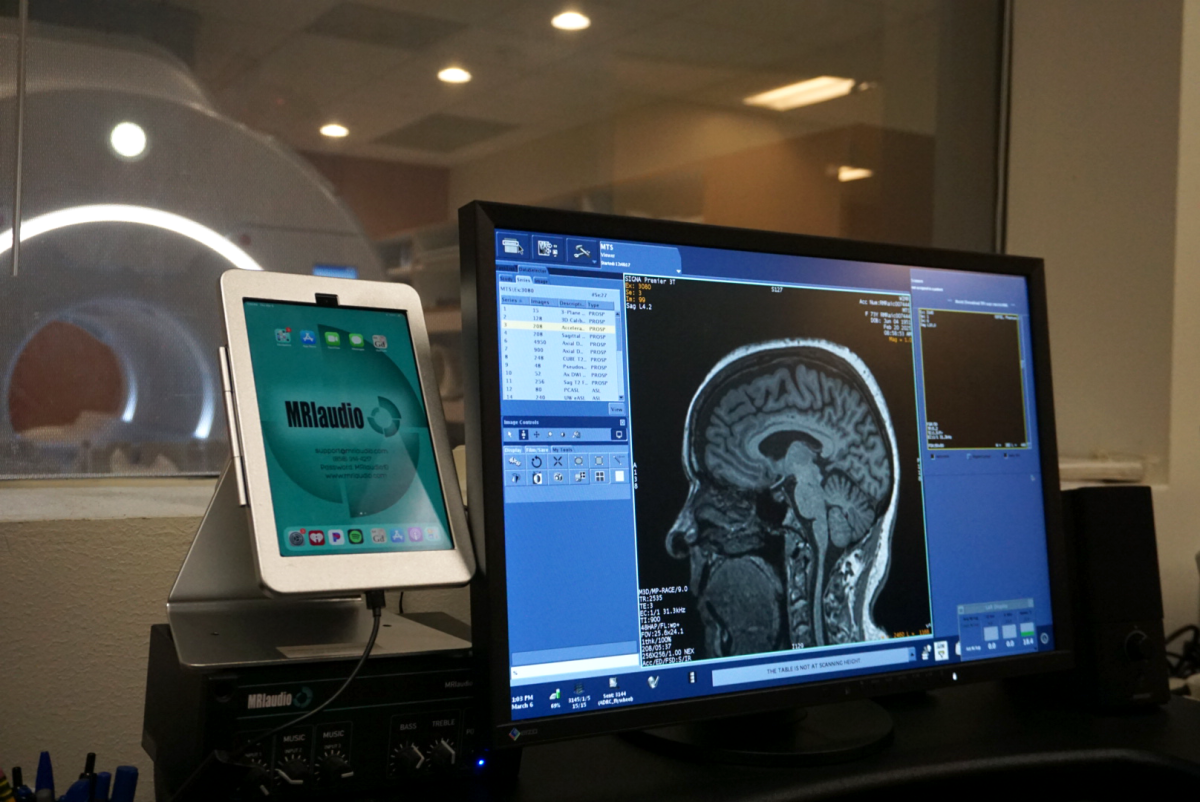

“[Artificial Intelligence] is everywhere,” professor and vice chair of research in the University of Wisconsin Department of Radiology, Dr. Christoph Lee, said.
Currently, UW is participating in a multi-institutional $16 million clinical trial testing future applications of AI assisting radiologists, specifically in breast cancer screenings. The trial hypothesizes that AI can pick up on imaging features that the human eye cannot, allowing for higher detection rates and the potential to save lives, according to Lee.
Breast cancer is the leading cause of cancer in women and the second highest cause of cancer deaths in women, according to physician radiologist and chief of the Breast Imaging Section within the UW Department of Radiology, Dr. Mai Elezaby. Additionally, about 40 million women undergo screening mammography in the United States every year, according to Lee.
“[Screening mammography] is pretty effective as a screening tool — about 87% of all cancers that are present can be detected on mammography, but that also means that about one in eight cancers are missed,” Lee said.
This is where AI tools for screening mammography come into play. Computer algorithms have been assisting in the diagnoses and screenings of breast cancer since the 1990s, according to Elezaby. By the 2000s, computer-aid detection or CAD was used in the majority of practices that participate in screening mammography to analyze images and potentially flag areas for radiologists to review, Elezaby said.
But, despite the rapid adoption of traditional CAD algorithms in the early 2000s, the technology lacked advanced testing, and it was found that CAD tools actually led to worse diagnostic accuracy and did not increase cancer detections, according to Lee. These discoveries led to a stop in reimbursement for CAD algorithms in 2016, Lee said.
“The further advancement of deep neural networks and the current AI algorithms are showing a more significant, robust performance improvement than the older computer models,” Elezaby said.
According to Lee, the history of CAD algorithms and its subpar impact is one of the big motivations for the trial. Those involved with the trial want certainty that newly emerging AI tools are effective and lead to positive patient outcomes before they are widely adopted, Lee said.
Current applications for AI are extensive, according to Elezaby. Generative AI can be used for helping patient communication, translating reports and creating simplified reports for patients, Elezaby said. Additionally, computer assisted diagnostic AI tools are used in mammography image analysis to mark areas of potential risk, significance or concern for radiologists to look further into, Elezaby said.
“When a radiologist is looking at the images, the AI is doing the same thing, and it’s analyzing the images in the back end, and marking spots for the radiologist to re-review or focus on a little bit more,” Elezaby said.
The FDA has cleared some AI technologies and tools, and initial studies have shown increases in cancer detection rates, including those missed by radiologists and decreases in false positives, according to Elezaby.
Yet, according to Elezaby, it is important not to be biased by positives but to really look at a product critically and assess the benefits, potential drawbacks, side effects and concerns that may come with the use of the tool. The randomized trial is helping to assess if AI can help radiologists detect more cancers without excessive recalls or false positive exams, Lee said.
“If AI picks up too many things that are benign, it could cause women to get unnecessary work ups, unnecessary biopsies. And that causes a lot of stress, anxiety and possibly physical harm,” Lee said.
Diagnostic AI tools in mammography may bring automation bias into play, where experienced radiologists may be swayed by the technology and go against their own instincts, knowledge or training, Elezaby said. Every positive may have a negative, and that is what the trial aims to explore, according to Elezaby.
UW has a lot of research opportunities for students, including projects and labs that are exploring the use of AI, both inside and outside the Department of Radiology, according to Elezaby. She encourages students who are interested in the biomedical fields or in computer sciences to explore some of these opportunities.
In the future, AI is going to have a huge presence in everyone’s healthcare, and it’s very exciting that UW is helping lead one of the first trials for AI in medical imaging, according to Lee.
“Everyone knows somebody that’s been affected by breast cancer,” Lee said. “If we can improve the ability for women to be detected earlier, and for their lives to be saved, that’s one of the biggest public health benefits that we can have in terms of population-based impact.”
