
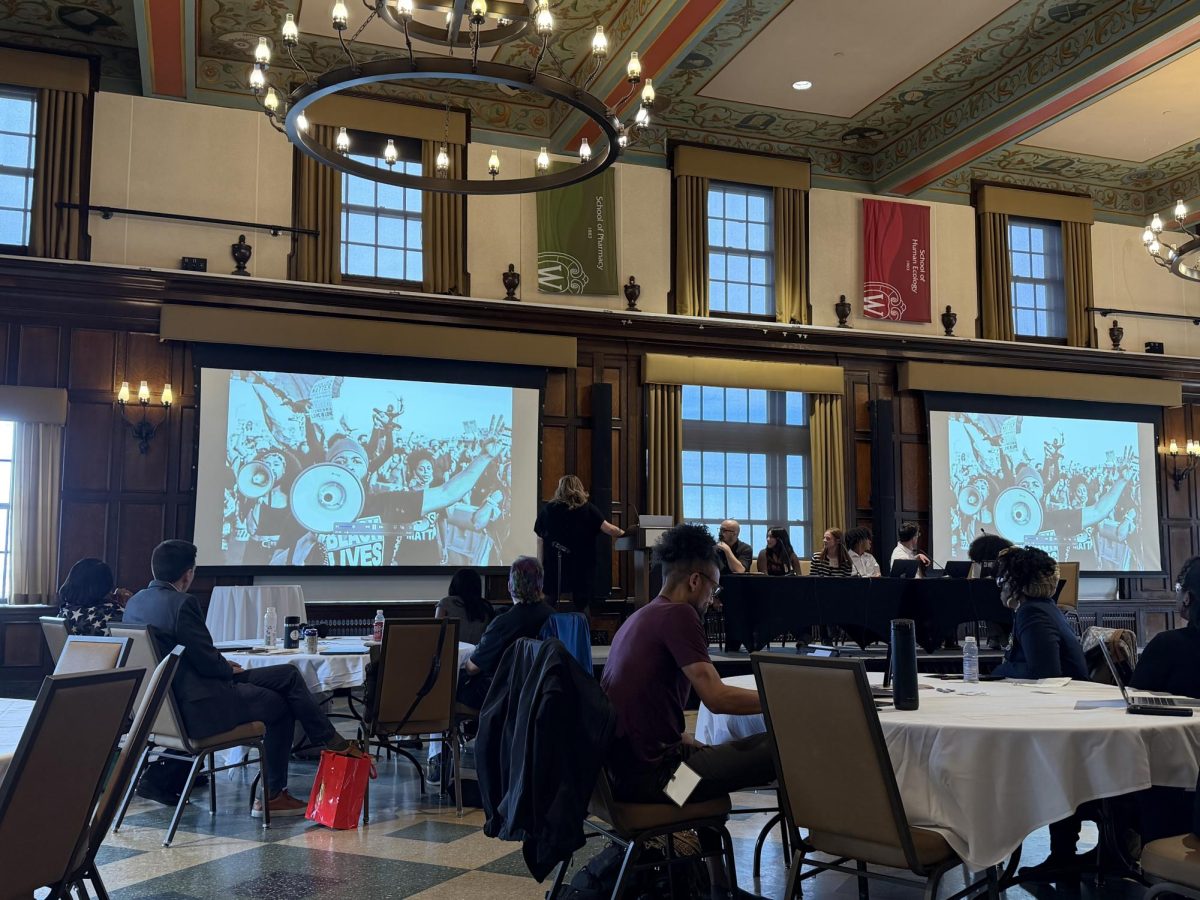

The Department of African American Studies at the University of Wisconsin hosted its second annual 2026 Student Symposium at the Tripp Commons in Memorial Union Feb. 27, sharing the voices of 21 students across four panels and one poetry reading.
Among these presentations, students across different backgrounds and areas of study presented their various research projects on Black history and culture and their personal experiences with the studies.
The panels were all moderated by professors in the Department of African American Studies and by UW student Heaven Williams, who formed the undergraduate planning committee for the symposium.
The free event began with breakfast and opening remarks, followed by a panel of four students titled “Pedagogies of Resistance and Possibility: Histories of Black Education.”
The other two panels of the morning, “Mapping Resistance and Reclaiming Space: Collective Action in Community” and “Praxis of Protest” showcased open discussions of past and present displays of Black resilience and individuals or groups of people who have practiced protest.
The students in this panel came from not only an African American studies background. Students Gabriela Mauricio and Vicki Ferrarini said their research on the interconnectedness of past and present Black liberation movements made them feel better prepared for their future careers in education and law.
“I’m going to be teaching 7th grade, hopefully history, and I just want to be able to make sure that all of my students’ voices are heard,” Mauricio said.
In her presentation “Praxis of Protest,” student Genesis Liriano examined the history of protest at UW, specifically looking into the university’s role.
“It felt like a reflection of my whole experience at UW,” Liriano said.
The afternoon portion of the symposium began with a panel titled “Let the world be a Black poem,” in which UW students Emil Matthews and Teja Davis read their original poetry.
Matthews said her work seeks to grapple with racial belonging, and Davis pointed her inspiration toward wanting to capture different aspects of the Black experience.
After lunch, attendants listened to a keynote address from professor of history at West Virginia University Austin McCoy, titled “‘Stakes is High’: De La Soul, Cultural Criticism, and a Political History of Rap in the 1990s.” The address featured discussions on his newly published book, “Living in a D.A.I.S.Y. Age: The Music, Culture, and World De La Soul Made.”
The event ended with another student panel on interdisciplinary approaches to African American Studies, awards and closing remarks.
At the end of the third panel, African American Studies professors commented that this symposium was made to give a space for students to share their emotions as well as their research, and that it’s important to feel things as they study.
The Department of African American Studies exists because of student protest, African American studies professor and department chair Christy Clark-Pujara said.
“We exist because of student protest, and I think it is critically important that faculty, staff and administrators take time to listen to what our students have to say and value their perspectives,” said Clark-Pujara.