



The Wisconsin Science Festival hosted a Crossroads of Ideas event at UW on Oct. 22. to showcase a combination of geological research and art. The event was titled ‘Crossroads of Ideas: Threading the Story of Earth’s Oldest Rocks.’ It featured talks by geologist PhD and Lab Manager for the UW-Madison SLEUTh LAB Emily Mixon and Madison–based textile artist Leah Evans.
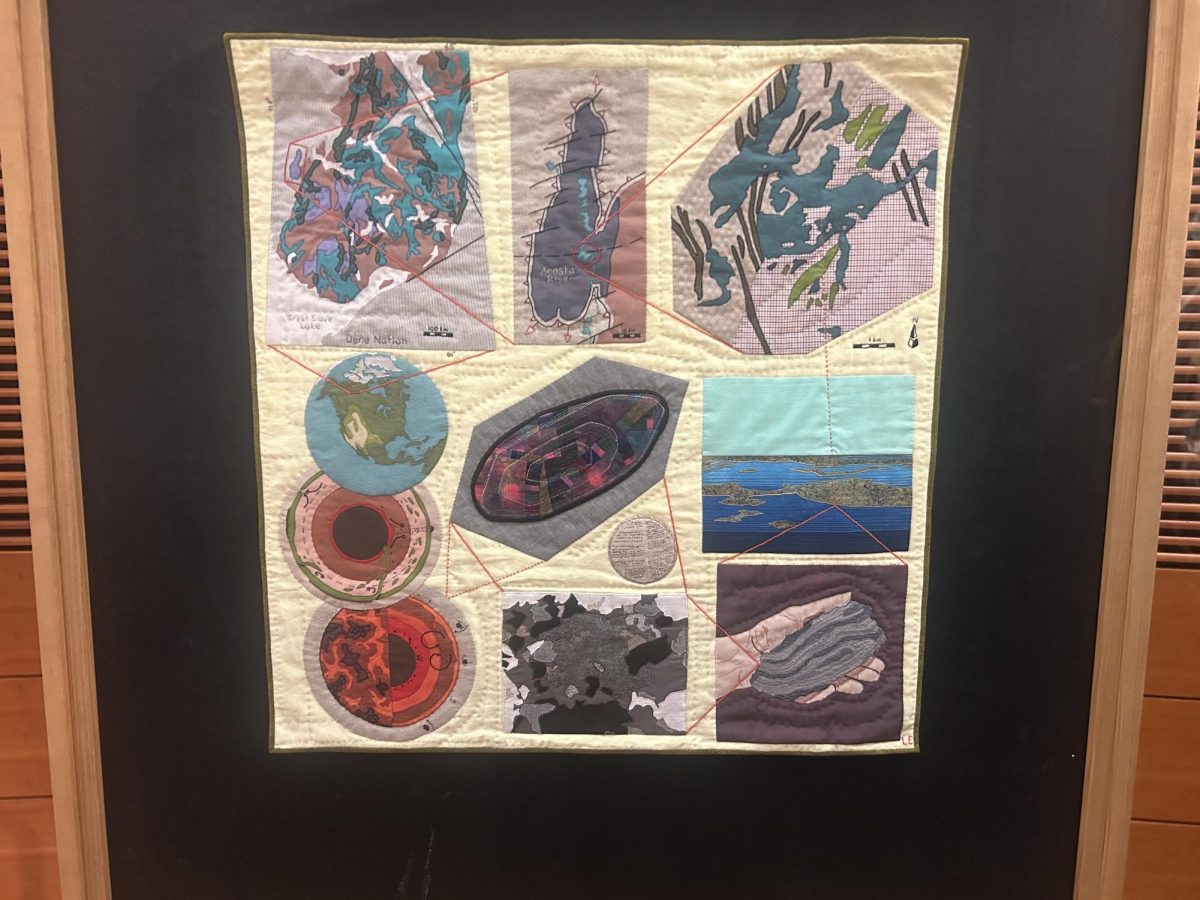
Evans collaborated with Assistant Professor of Geoscience Annie Bauer and her research group, which included Mixon, to bring their research on the Acasta Gneiss, the world’s oldest known rock, alive in the form of an artistic quilt.
The event began from remarks by UW-Madison Geology Museum Associate Director, Brooke Norsted. Mixon gave a talk on the main goals and results of their recent research. She and her coworkers studied the Acasta Gneiss, a rock formation dated to be 4.02 billion years old, according to Mixon.
Her research involved crushing up samples of this rock and separating out zircon crystals. By analyzing these small crystals, they are able to determine processes happening in the Earth over billions of years ago, a concept that geologists call “deep time,” according to Mixon.
From oxygen signatures, trace elements and crust recycling they corroborate geological hypotheses and data that indicate when the Earth became inhabitable, according to Mixon.
“Other work…has shown that there’s liquid water quite early on Earth. We’re seeing [this] at Acasta,” Mixon said.
Evans spoke about her creative process. She likened her detailed process to the detailed process of the scientists. She has to pick out recycled fabric, carefully cut and lay out pieces and spend time making deliberate stitches. Mixon and coworkers also did detail work, manually separating and investing tiny crystals under the microscope.
She spent a lot of time reflecting on her creative process, the scientific process and the geologists’ emotional connection to their research.
“As I’m doing these tedious elements of the piece, I’m thinking of what the scientists think about and their experiences in the field, processing and mounting these tiny pieces,” Mixon said.
The event also included a panel discussion, moderated by Norsted and including Evans, Mixon, Bauer and UW Geoscience Research Scientist Tyler Blum.
The quilt itself was unveiled at the event. It included quilted inset maps of the area where the Acasta Gneiss was found at various zooms, an aerial view of the island where it is located, images of the zircon, images of the Earth at various times across billions of years and a hand holding a rock. Red lines tie the work together, meant to show the interconnectedness of the different motifs and moving through the rock cycle and time, according to Evans.
Panelists spoke of the way the Evans’s quilt renewed their sense of awe about the Acasta Gneiss. Bauer had first visited the Gneiss more than a decade ago. At the time, she had been overwhelmed with wonder, but she’s been entangled in the day-to-day of data collection ever since. Seeing the quilt gave her the chance to step back and see the beauty again, Bauer said.
“Seeing all of this through Leah’s eyes gave me a new sense of awe,” Bauer said.

