


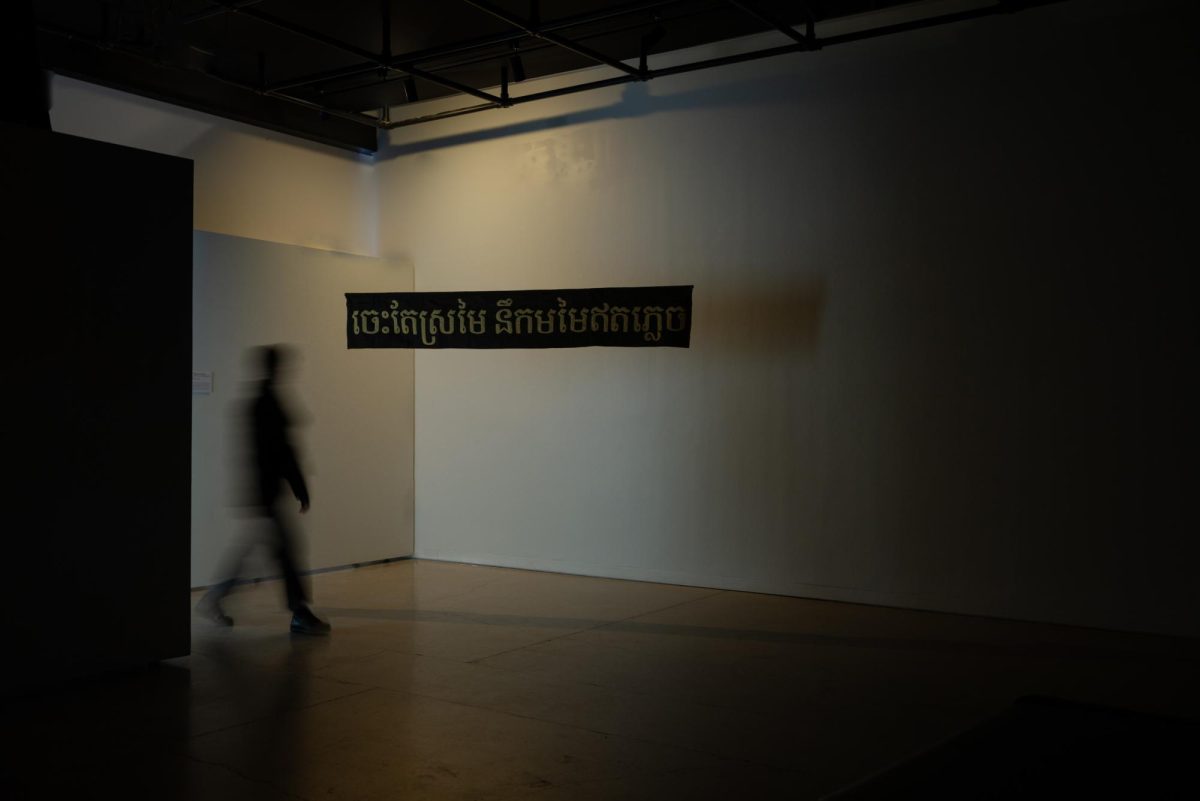

UW’s Art Lofts Main Gallery opened “Ghost Writer: Someone Who Writes Something for Someone Else” on Feb. 4, 2026. The Master of Fine Arts qualifier exhibition examines artist Daniella Thach’s Cambodian American identity and what it means to merge timelines across familial memory. Thach hopes to shed light on the 50th anniversary of the Cambodian genocide with the exhibit, according to the announcement.
Between 1975 and 1979, the communist political group the Khmer Rouge killed between 1.5 million and 3 million people in what is known as the Cambodian genocide. The genocide was an attempt by the Khmer Rouge to create a classless, agrarian society. The regime collapsed when neighboring Vietnam invaded and occupied the country.
Thach’s parents grew up in different countries. Their mother was raised in Cambodia, and their father in Vietnam. The two later met in Chicago.
Although Thach’s parents spoke different languages, English became their common language. Thach was taught only English in hopes it would provide the best opportunities in the United States. However, Thach said they feel disconnected from Cambodian culture because of their upbringing. That tension influenced their current exhibition.
“There’s something about the concept of a third culture kid, growing up displaced from where your family grew up,” Thach said. “The impetus for a lot of my work was not being able to speak their language and communicate with them.”
The exhibition draws on Thach’s experience as a third culture kid and the process of reconnecting with a culture shaped by displacement.
Thach said they view the concept of a ghost writer in a cultural context as immersing oneself fully in language and history.
“As a ghost writer, I really wanted to embody someone who knows and understands the language forwards and backwards,” Thach said. “The Cambodian translation comes from flipping through my grandfather’s journals after he passed and realizing he was teaching himself English.”
Thach said ongoing global conflicts also motivated the exhibit. As a descendant of genocide, they said they feel compelled to reflect on histories that have been overlooked.
“I hope that there is some hope for those in Palestine, Sudan, Iran,” Thach said. “I would like to hold their hands in a way that art could voice.”
The exhibition is on view in the Art Lofts Gallery through Feb. 9. A reception was held Feb. 7.
