


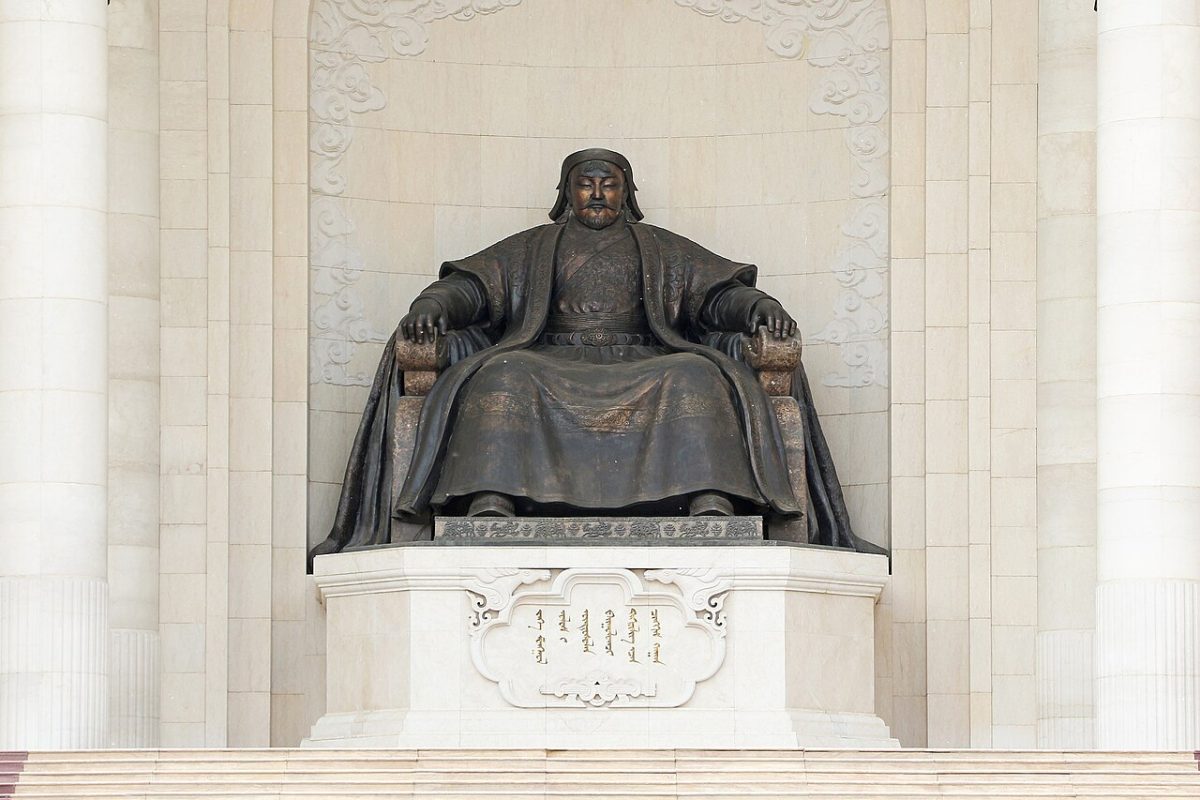

The Mongol Empire holds an important and mysterious place in the history of central Eurasia, and has since piqued the interest of many researchers. One of these researchers is Ayken Askapuli, a PhD candidate in the Department of Integrative Biology at the University of Wisconsin. Askapuli and his archeologist colleagues in Kazakhstan are interested in testing the folklore-based hypotheses regarding buried relatives of Genghis Khan from medieval Mongolia in central Kazakhstan.
In collaboration with colleagues in Japan at the National Institute of Genetics in Mishima, Askapuli and his colleagues analyzed ancient genomic data to explore the possibility that a tomb they studied belonged to Genghis Khan’s eldest son, Joshi. The tomb is dedicated to Joshi, but is ambiguous, for it lacks any tombstone or specific note of who was buried there, according to Aksapuli. This prompts the need for genetic testing, Askapuli said. Researchers were able to obtain genomic data from all four tombs, but they weren’t able to definitively prove that any of the people in the tombs were related to Genghis Khan, according to the article.
“Testing the specific identity of those individuals was still difficult for us, even though we had genomic data, because we still do not have a reference genome from Genghis Khan’s true relatives,” Askapuli said.
For this reason, the team was not able to prove or disprove 100% that the tomb belonged to Joshi, according to Askapuli. But, the four individuals from the mausoleum do share the same genomic background, meaning that they belong to the same population, Askapuli said.
In 2003, an influential paper was published, claiming that 1 in 200 men worldwide are descendants of Genghis Khan, according to Askapuli. The paper also claimed to have found the signature haplotype of Genghis Khan, the C3* cluster, which was later linked to the C3* cluster haplogroup, Askapuli said. In Askapuli’s study, three of the four tombs were male, and Askapuli found the C3* cluster haplogroup in all three.
“They [the three males] belong to a specific sub-branch of that C3* cluster haplogroup, which implies that at the time of Genghis Khan and the Mongol Empire, this lineage already diversified,” Askapuli said. “This particular haplotype occurs in modern human populations, but at very low frequencies.”
This finding further disproves the theory that 1 in 200 men are descendants of Genghis Khan, because the specific haplotype occurs so infrequently in the modern population, according to Askapuli. This is further supported by previous research and dating of modern human lineages that have disproved the prior claim that 1 in 200 men are descendants of Genghis Khan, according to Askapuli.
Askapuli stresses the need for international collaboration in order to achieve meaningful results, as samples were excavated by archaeologists in Kazakhstan, data was generated in Japan and results were analyzed at UW, according to Askapuli.
“This project has been completed successfully because of this broad international collaboration,” Askapuli said. “I think this is advice to undergraduate students to broaden their perspectives, to collaborate with so many different people.”
