

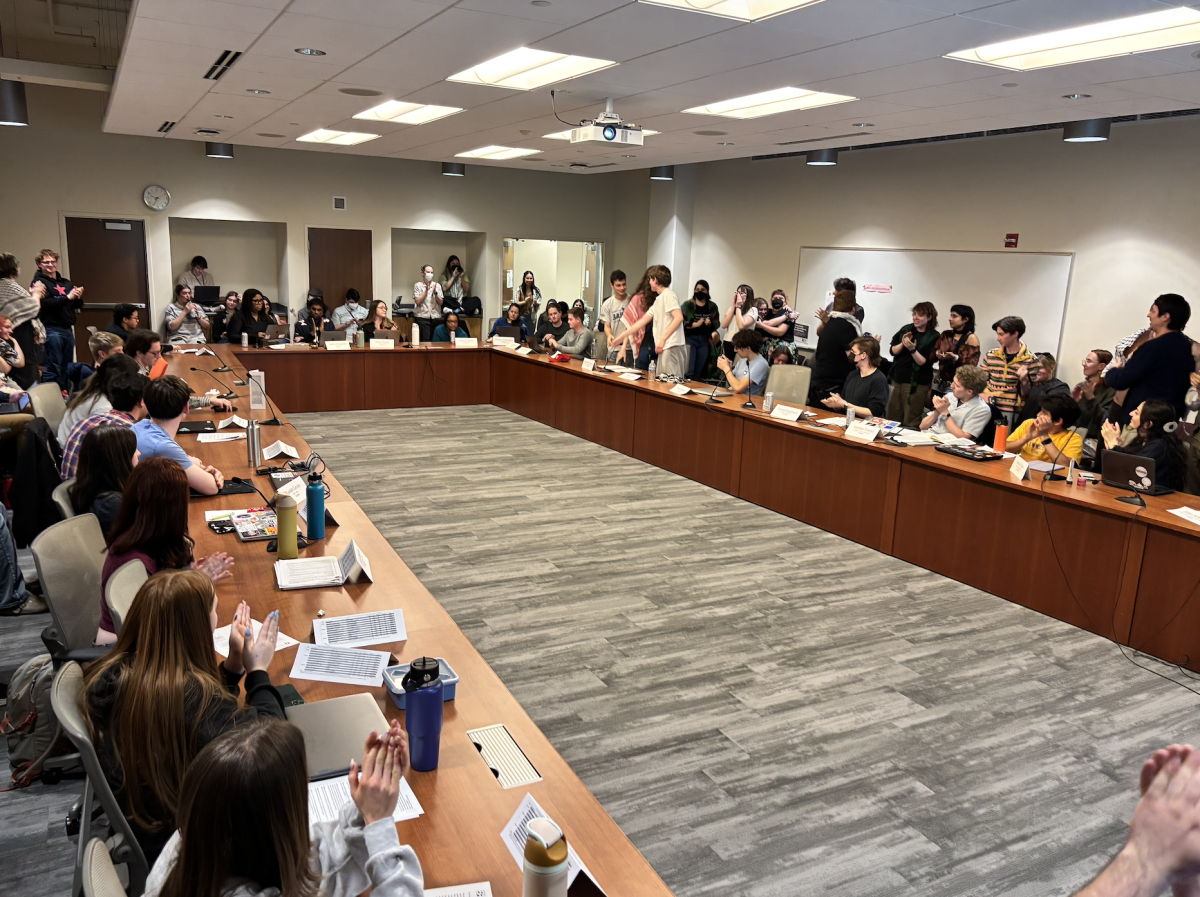

The Associated Students of Madison voted 15-5-3 Wednesday to pass anti-discrimination divestment legislation introduced at the last meeting held March 18.
The legislation calls for divestment from BlackRock index funds containing holdings in companies that manufacture weapons for Israel’s military operations and the Rapid Support Forces in Sudan, as well as corporations that have contracts with Immigration and Customs Enforcement, according to the legislation.
The legislation argues these investments may violate Wisconsin state statute 36.29(1) — which prohibits University of Wisconsin investments from being knowingly made with a group that practices or condones discrimination — on the basis of reports of genocide in Gaza and Sudan and abuse perpetuated by ICE.
“That’s what a vote ‘yes’ on this resolution means, it means we don’t believe our investments should be made in discriminations against other people,” ASM representative and bill cosponsor Roman Fritz said. “I object to any consideration that it would increase discrimination.”
The legislation passed during the special open forum meeting called in order to finish debate — which was cut short during the prior meeting — and vote on the matter ahead of UW’s spring break recess.
Several students and community members, both Jewish and non-Jewish, spoke in opposition to the bill at the previous meeting over the bill’s inclusion of Israel and reports finding that its military operations against Gaza align with genocide, citing concerns with antisemitism.
“Past similar resolutions, like ours, like this one right here, that call and name Israel a bunch of times in the legislation, and that gets passed, it is in the wake of antisemitic hate on campuses increasing by 2.6 times,” ASM representative Amitabha Shatdal said.
At the special open forum, two people spoke in opposition to the legislation at the beginning of the meeting after a motion was passed to move speaker Anna Lotan to the start of the agenda, in stark contrast with the comparable amount of last week’s speakers both for and against the bill.
Nearly 35 people spoke in favor of the legislation at the March 25 meeting, and around 20 people did the same at the meeting during which the bill was proposed.
After the two speakers opposed to the bill finished their speeches, approximately 30 students and community members exited the meeting.
“The fallout of this resolution will be the isolation and harassment of Jews on our campus,” Jewish student Ariav Hayempour said. “Our fears are well-founded. The bigotry began this process, led by members of ASM. Certain representatives were caught using a disgusting anti-Jew slur referring to Jews as ‘zi—s.’”
UW released a statement saying they are reviewing reports that ASM representatives used the antisemitic term in an online chat in reference to allegedly preventing certain people from speaking at the March 18 meeting.
Yoni Greenspan said ASM representative Gabo Ochoa Samoff said he was considering not extending open forum because too many “zi—s” were signing up for open forum during the previous meeting. Ochoa Samoff seconded a motion to extend the open forum during the meeting, however.
“As a Jewish student, and as someone who feels deeply the harms and the menace of antisemitism, I apologize in whatever capacity I can for anything I have said that has done anybody harm,” Ochoa Samoff said. “This bill seeks only to make our university more ethical in its investments and less discriminatory.”
Hillel at UW said ASM’s bias was revealed by the alleged antisemitic online message, according to an email statement from Hillel director of community relations Aaron Seligman.
Hillel said it is deeply disappointed that ASM passed an “antisemitic Boycott, Divestment and Sanctions” bill, according to the email.
“There is, contrary to what opponents of this bill will have you believe, not a singular Jewish community or Jewish voice that feels the same way about this legislation,” Jewish student Lily Shell said. “Yes, the bill mentions Israel’s actions in Palestine. No one will say that it doesn’t, but it also mentions Sudan, the UAE and ICE.”
Editor’s note: This article was updated to include the correct number of votes on the resolution.

