


The Madison Children’s Museum hosted Feb. 19 its Black Heritage Month Celebration. This event was free and open to the public, featuring food, music, art and dance that represented Black culture and traditions. The celebration honored the contributions of Black people in the Madison community.
Performances featured Children’s African Story Time and L.E.X, a Hip-Hop artist. Visitors also enjoyed sign-making, face painting, Black Heritage Art activities, a selfie station and more at the Black Heritage Month Celebration.
The Madison Children’s Museum offered free Soul food samples from Melly Mell’s catering and a pay-what-you-can cafe for attendees to enjoy.
One of the featured exhibits was Da Hoodzeum, “a traveling, community-focused, immersive museum and archival experience,” according to the Madison Children’s Museum. Michael Davis is the exhibit’s founder and curator.
“I think the ancestors called me, the cosmos called me, to develop an archive that is not only community-centered, but that focuses on a more radical aspect of history,” Davis said.
The Da Hoodzeum exhibit features over 4,000 artifacts. Displayed artifacts are from Black sociopolitical and cultural movements from the 1800s to the present day, according to Davis. The exhibit at the Madison Children’s Museum is consolidated and curated to center around young people and children, according to Davis.
Some of the artifacts include original Black Panther Party newspapers from the late 1960s and early 1970s, according to Davis.
The Black Panther Party, founded in 1966, sought to protect Black people from brutality. Members of the party confronted politicians and challenged the police, according to the National Museum of African American History & Culture. Known as “survival programs,” the party’s community initiatives provided essential resources such as food, clothing and transportation.
“The Black Panther Party newspaper was just meant to inform Black people with a more radical and sharpened analysis around what was happening in the world,” Davis said. “How should we think about police violence? How should we think about police brutality? How should we think about capitalism and prisons and food and colonization and all of these things?”
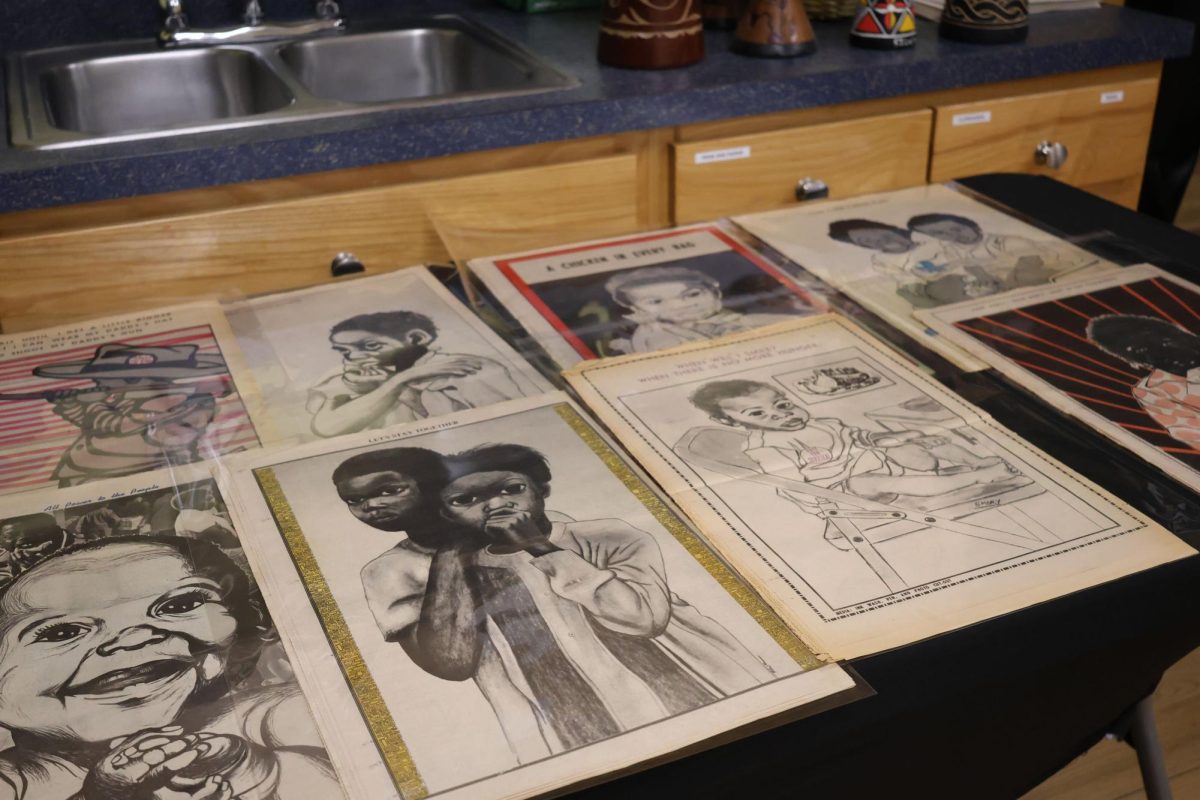
Emory Douglas, Minister of Culture for the Black Panther Party, created captivating artwork for the newspapers to draw attention to the publication, Davis said.
For this curation, Davis selected newspapers that centered around children either as victims of an anti-Black world or as those who stand up against that anti-Black world.
“[The Black Panther Party] put their emblem on everything,” Davis said. “Cultural organizing was very important for the Black Panther Party so that it was known, so people would know that it was serving them, so they could get down too. And it looked cool, you know?”
Another collection in the Da Hoodzeum exhibit features artifacts from the Black Panther Party’s Detroit youth center and their liberation school. A carpet square, a tray and a clock from the school’s classrooms are included in this collection.
Some artifacts in this collection from Black Panther Party’s Detroit chapter include the phrase “Practical Learning.”
“‘Practical Learning’ meant: what is a pedagogy, what is a style of learning that we could actually use to free ourselves?” Davis said. “Not education for education’s sake, but education with a very serious and intentional political focus.”
The exhibit featured a table to highlight the Black Panther Party’s mutual aid work. Some of the highlighted initiatives were the free breakfast program, liberation school and free health center. They also had programs for free pest control, furniture, acupuncture and buses to prisons to see incarcerated parents who were political fighters, according to Davis.
All featured items are original and were handled and used by the Black Panther Party, according to Davis.
Davis also brought toys dating from the 1980s to the present day. One of the displayed brands is Olmec Toys, created by a Black woman, which had the industry’s largest selection of Black and Hispanic toys. Founded by Yla Eason, Olmec Toys was pushed out by big toy companies, according to Davis.
“I think people fail to realize, when we think about the Black Panther Party, even the Civil Rights movement, how young those people were,” Davis said. “Like how a lot of the Black Panther Party members were teenagers, or the Children’s Crusade in [1963] that helped reenergize the Civil Rights movement — there were 8 and 9-year-olds out there.”
Through Da Hoodzeum, Davis highlights the histories that are erased and ignored. Intentionally, lots of the artifacts in Da Hoodzeum feature young people fighting back.
By highlighting children in content, Davis demonstrates how young people have been active participants in resistance and social change.
“We are always in this time where history, especially Black history, is completely erased or taken and whitewashed and reconfigured into something else,” Davis said. “But, when you have the original artifacts and pieces in your hands, I just think that transforms you in some way.”
You can keep up with Michael Davis and the Da Hoodzeum exhibit on their Instagram (@dahoodzeum).