



Warning: Spoilers for “Wuthering Heights” (book and movie) ahead!
When the trailer for director Emerald Fennell’s latest film, “Wuthering Heights,” dropped, it promised to be a romantic epic worthy of its Valentine’s Day release date.
Over a montage of Victorian-era vignettes — tightening corsets, emerging mysteriously through fog and broodingly leading a horse across windy English moors — elegant white text declared the movie to be “inspired by the greatest love story of all time.”
A bold claim indeed. The love story being referred to here is, of course, the novel from which the film borrows its name and presumably, its plot — Emily Brontë’s 1847 masterwork, “Wuthering Heights.”
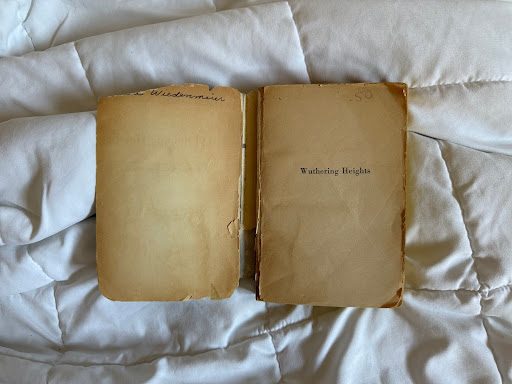
I’m not a fan of classic literature, but I had to see for myself if this “Wuthering Heights” was truly the greatest love story of all time. I dislodged my dilapidated paperback copy of the novel from my bookshelf and prepared to swoon.
It took me nearly a month to work my way through all 406 pages of Brontë’s flowery prose, but I did it — just an hour before departing to see the film on the big screen.
Here’s what I learned from reading “Wuthering Heights.” One, Brontë is obsessed with the word “ejaculated” (and no, it’s not being used in the way you’re thinking) and two, “Wuthering Heights” is hardly a love story.
In fact, I’d say it’s more akin to a Greek tragedy than a romance novel. The multi-generational drama, set against the backdrop of storm-battered Yorkshire moors in the early 19th century, documents the obsessive relationship between Catherine Earnshaw, a high-spirited young woman, and Heathcliff, a surly orphan, and the carnage their impassioned affair leaves in its wake.
It’s a bitter tale of jealousy and revenge, full of petulant children and abusive parents, that explores issues like class inequality and generational trauma. I expected the “Wuthering Heights” novel to give me butterflies — it gave me a pit in my stomach instead.
Though I derived a sense of inflated self-importance from reading a work of classic literature, when I closed “Wuthering Heights,” I felt somewhat relieved it was over. I awarded it three out of five stars.
Going into Fennell’s adaptation of the novel, I knew I’d be dealing with an entirely different beast. I was already disquieted to see that, apart from me and my posse of friends, our viewing of the film was solely attended by a scattering of elderly adults who I could only guess were fans of the novel.
They must have been sorely disappointed, because Fennell’s “Wuthering Heights” strayed so far from the original source material that I would scarcely even call it an adaptation.
I think a more accurate title for the film would have been “Wuthering Heights Reloaded: Hotter, Sexier and Hornier,” or “Stylized Montage of Jacob Elordi and Margot Robbie Having Sex in Victorian-Era Garb (No Nudity — Who Do You Think We Are?).”
I wasn’t surprised — I mean, this is the woman who directed the all-style-no-substance 2023 sensation that was “Saltburn.” “Wuthering Heights” feels like Fennell’s own fan fiction of the classic novel it’s based on, adapted to the big screen with all the bells and whistles suited to a big-budget Hollywood film, including two attractive A-listers playing the leads and a rhapsodic soundtrack by arguably the hottest popstar of the moment.
All that being said, I thought I’d hate the film, and yet, I found myself strangely endeared to it. Sure, it’s soapy and overdramatic, but so was the book. The foreword to my 1966 edition of the novel puts it this way: “no other English novel has such intensity of feeling, such wild strangeness of imagination.”
I don’t doubt that Fennell felt all of those emotions when she read “Wuthering Heights,” but I think when translating the story to film, she failed to uncover the delicate themes lurking beneath the narrative’s thick layer of pomp and circumstance. As a result, the film is just as shallow as the peat bogs of the Yorkshire moors where the story is set.
Sometimes, admittedly, shallow worked just fine. The “Wuthering Heights” film was at its best when it leaned into its campiness, and I appreciate Fennell was brave enough to ask — what if Heathcliff wore a tiny gold earring?
The sets were immersive and the costumes were deliciously maximalist. I particularly liked the evolution of Earnshaw’s style after she finds a wealthy husband and is seduced by the trappings of upper-class life, donning floppy wide-brimmed hats and dramatic veils that whip about in the wind.
Is a low-cut black gown that glistens as if it’s made of latex historically accurate? No, but the sheer over-the-toppedness of such outfits almost sold me on Fennell’s sugar-coated, steamy take on “Wuthering Heights.” Like sex, the film is indulgent, sensual and glamorous, fueled by aesthetics, passion and pleasure.
If Fennell’s goal with “Wuthering Heights” was to make something beautiful to look at, she succeeded, although after a while, the glittery montages start to feel a little bit masturbatory and the no-nudity sex scenes lose their edge. As the film neared its end, I found myself missing the novel’s whip-smart dialogue and exploration of love beyond just sex.
That’s why, at the end of the day, Fennell’s “Wuthering Heights” is the cinematic equivalent of empty calories. If the original novel is a plate of vegetables, the film is a 10-tier cake topped with whipped cream and cherries. It looks beautiful, and the frosting tastes sweet, but cut that cake open and it’s hollow — and now you have a cavity for nothing.
When I left the theater after seeing “Wuthering Heights,” I began to wonder if I’d been too harsh on Brontë’s novel. Maybe it deserved three and a half stars. Perhaps even four. That’s what a bad film adaptation will do — it’ll make you realize that yeah, the book was better, even if it wasn’t all that good to begin with.
