
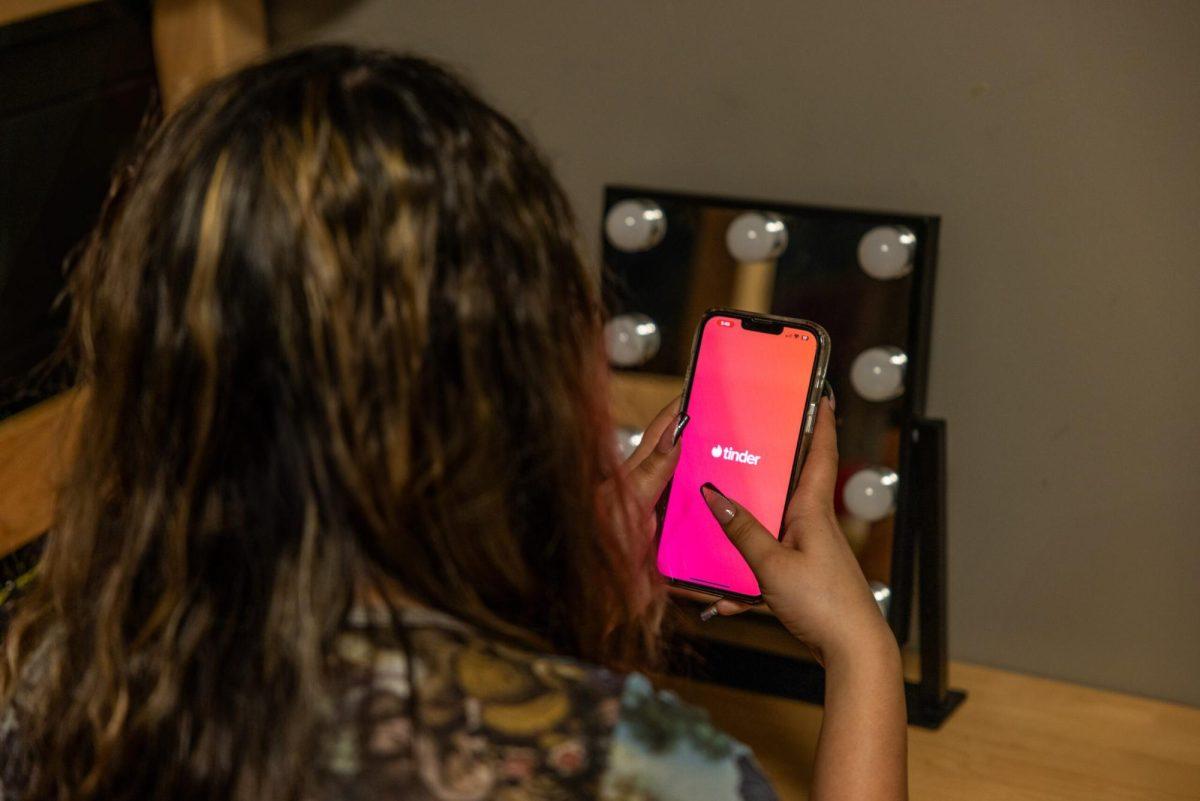

In the name of research, courageous reporters like myself have gone to some truly terrifying places. Last week, I cemented myself among the bravest of them all when I, armed with nothing but my base journalistic instincts, explored uncharted territory — the Hinge feed of a 21-year-old woman.
It was my friend’s account. Huddled together on her living room couch, we spent the better part of 15 minutes scrolling and swiping and giggling.
“I’m not really looking for anything real,” she told me. “I just like the validation.”
But as we swiped through her backlog of admirers, I did not get the impression she was enjoying the so-called “validation” at all.
One suitor’s response to the prompt, “A life goal of mine” was something along the lines of, “To grow old and build a life with someone who makes me smile.”
“Ew,” my friend proclaimed, her mouth twisted into a grimace. I looked at her and wondered: Have dating apps truly conditioned us to be this cynical when it comes to romance?
It hasn’t always been this way. In a 2003 Badger Herald article titled “Dating gets convenient,” reporter Meredith Dietrich called online dating “extremely convenient because finding a date for the weekend is as easy as logging onto the Internet.”
While I admire Dietrich’s optimism, I can’t help but scoff at the idea that online dating could ever be considered easy. But maybe back then, it really was plausible for long-term relationships to begin online. I bet in 2003, e-dating at the very least provided a nice distraction from all the war crimes the U.S. was committing in Iraq.
Admittedly, I don’t know much about what online dating was like 23 years ago — at that time, I was but the size of a coconut, having a great time growing lungs while floating in a warm sea of amniotic fluid — but I can certainly speak on the current state of online dating, and I can confidently declare that finding a date for the weekend is no longer as easy as logging onto the Internet. I don’t even think “logging onto the Internet” is still a thing people do.
Online dating — and dating in general — has lost a good deal of its luster since The Badger Herald published “Dating gets convenient” in 2003. Even two years later, in 2005, Herald reporter Aubre Andrus adopted a much more pragmatic perspective on online dating with the article “Internet hookups provide little mystery.”
“The Internet tries to make dating as easy as possible. But is it supposed to be easy?” Andrus wrote. “I thought half the fun about dating is getting to know someone and letting them surprise you.”
I’m inclined to agree with Andrus, but I will note that it’s definitely still possible to be surprised by people you meet on dating apps. For example, on your 10th date, a Tinder match might admit that, though he explicitly stated in his profile that he’s looking for a long-term relationship, he was actually lying and all he wants is to hook up. See, what a surprise!
Olivia, a junior at the University of Wisconsin, has observed firsthand the lying epidemic that’s poisoned dating apps.
“I think that someone on a dating app is more compelled to lie about what they want in order to find someone to hook up with,” she said. “I think that it’s really hard, at least in my experience, to find someone who’s going to communicate with you what they actually want instead of what they think you want to hear.”
Mary, another UW junior, has noticed the same concerning trend in e-dating.
“It’s deceptive,” said Mary, who uses she/they pronouns. “I’m only on Hinge, and there’s the ‘short-term relationship, open to long.’ That never means actually ‘short-term relationship, open to long,’ you know?”
It shouldn’t be a surprise that dating app users aren’t always honest — it’s much easier to type a lie in a Hinge prompt than to tell one to someone’s face. Think of all the men on dating apps who select “not political” for their political affiliation instead of admitting they’re fascists. They probably feel so proud of themselves for showing such restraint.
According to Mary and Olivia, romance-curious college students would be considerably more likely to secure a date if they set aside their phones and picked up a book instead.
“Intelligence is the number one trait I value in a potential partner,” Olivia said. But, she’s struggled to find romantic partners — on dating apps and out in the wild — who feel the same way.
So has Mary. They recall going on a date with a man who confessed that over the course of his entire life, he hadn’t even read 50 books.
“I was like, ‘You’re 22!’” Mary said. “What do you mean you haven’t read 50 books in your life? What?” (Mary herself tries to read 50 books … per year.)
Olivia is of the opinion that everyone involved in the dating scene should commit to reading a book at least once every other month. Perhaps that would help prevent witless spelling mistakes like one Hinge message she received from a grammatically challenged suitor, reading, “Your so hot.” When Olivia corrected him, he mysteriously disappeared from her DMs, she said — for the best, as people who can’t tell their ‘your’ from their ‘you’re’ probably don’t make for great life partners, anyway.
At best, dating apps are entertaining, and at worst, they’re insulting. But for the time being, they don’t seem to be going anywhere — though I’m sure that in 20 years, we won’t occupy ourselves with e-dating or even dating for that matter, because our personal AI assistants will do our courting and our flirting and our fornicating for us.
So, get some romance in while you still can — just know that you’ll probably catch more potential paramours with a book in hand than with a Hinge profile full of lies.

