


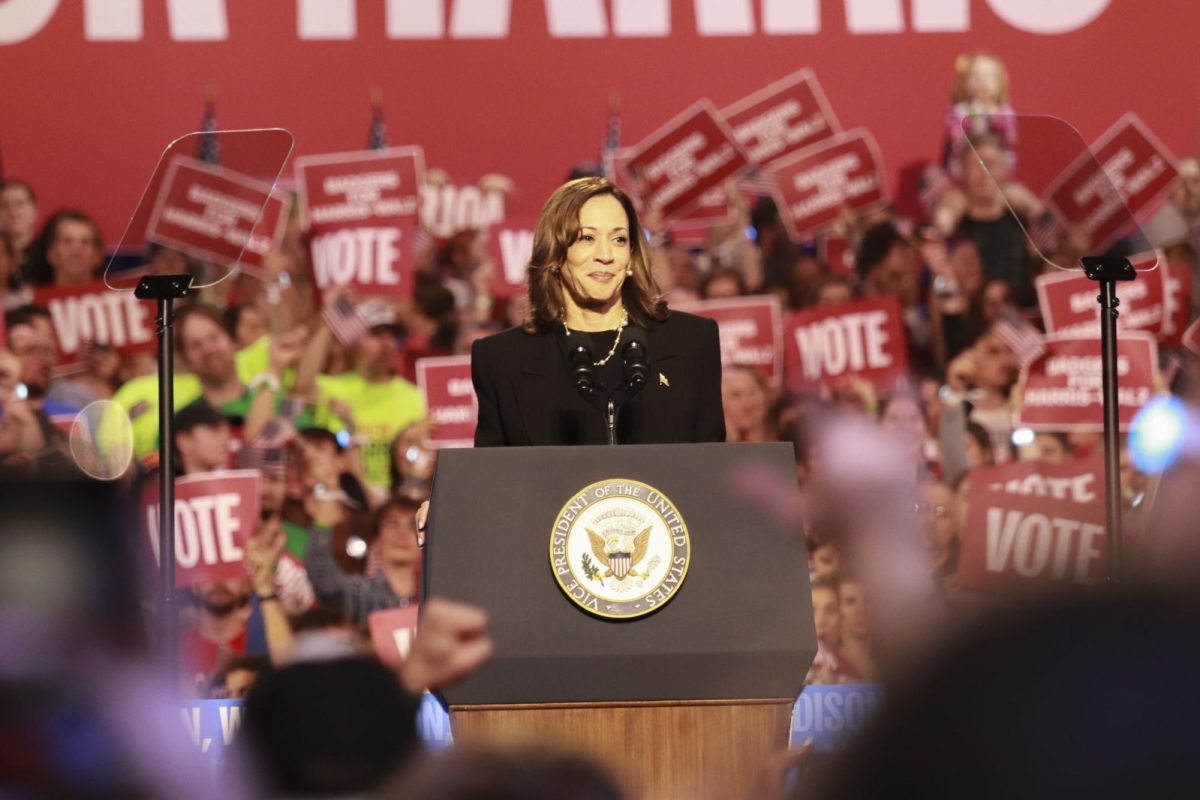

“I was on my feet the whole time. It’s a test of endurance as much as anything. Keeping up the energy, staying focused. Questions I’d prepared for, new ones that I hadn’t. And always, under the glare of the lights, the digital clock flashing.”
This excerpt from former Vice President and presidential candidate Kamala Harris’ new memoir, “107 Days,” embodies much of the aims and contents of the book. Published Sept. 23, the memoir explores Harris’ 107-day-long campaign for the White House last year.
The work is, as one would expect, written like a retrospective diary — Harris discusses what she did on each day and often weighs in on her opinions during and after the fact.
Certain hot topics have dominated the news cycle already. Harris refers to Biden’s decision to run again as “reckless” and claims he and his team hampered her re-election prospects. Gavin Newsom ignored her, Josh Shapiro wanted to be a co-president instead of a vice president, Pete Buttigieg was her first VP pick before she backed away from an incredibly diverse ticket and so on.
Many of these quotes come from what I refer to as the “defensive Harris.” She is one of three Harrises in the book.
The first, defensive Harris, who — while acknowledging some blame — defends her electoral loss, often attributed to a lack of time or support from others.
Though some of her claims are valid, this Harris struck me as a bit too bitter and unwilling to admit to major shortcomings. It is valid to criticize other politicians from your party who could have supported you more. Yet at times, Harris seemed to be clearing her name at the cost of others instead of providing lessons Democrats can learn from, herself included.
I call the second Harris the “orator Harris.” There are points when she speaks at length about the issues that dominated her campaign and continue to dominate American politics in Trump’s first term. Many of these function as what-ifs — a view into the country if she were to have won the election.
These segments are more inconsistent — they range from interesting and uplifting to feeling performative and slightly at odds with the Harris the nation saw on the campaign trail. I found myself inspired at some points, certainly, but just as often wondered if her words benefited from her lack of office (she spoke from the perspective of not being in office herself).
Considering Harris makes it rather clear that she will return to politics — though in what way is unknown, likely even to her — we will have to see if the orator and the politician come into conflict in the future.
Lastly, the best parts of the book come from the “person Harris.” Forgive the generic and even hackneyed title here, but the person Harris is the daughter, sister, wife, mother and human undergoing what is perhaps one of the most difficult jobs anyone can have in the world.
I was most impacted by the passages in which Harris catches up with her children between long periods on the trail, fights and makes amends with her husband Doug, and reflects on how her beliefs and actions were inspired by her since-passed mother.
Harris is unafraid to pull any punches in this regard — she openly discussed many of her fears, frustrations and initial reactions during her campaign. For a candidate whom many Americans reported not knowing much about, one can catch a real glimpse into the “person” Harris is in “107 Days,” strengths, flaws and all.
“107 Days” is, of course, a major book released by a presidential candidate in one of the nation’s most competitive elections in history. To weigh the nature of her arguments and even their effects, I spoke with University of Wisconsin journalism assistant professor Ross Dahlke who studies political information exposure.
Harris’ belief that a shorter campaign length harmed her chances is fairly logical, according to Dahlke. He said quite a few factors that were absent as a result, such as more advertisement time, a primary competition, could have helped her succeed, while noting that the unpopularity stemming from her association with Biden would play a role regardless.
“It’s a bit of a double-edged sword,” Dahlke said.
Dahlke said Harris’ criticisms are unlikely to divide the Democratic Party in any meaningful way, considering her lower prevalence in national politics since the election.
“It’s not like Harris is the out and out leader of the Democratic Party right now … if she were the sitting president and released a memoir criticizing democratic governors, that would probably be more of a concern for the Party,” Dahlke said.
I also spoke to Dahlke about the role of political memoirs in American politics more generally. According to Dahlke, it is difficult to measure the impact of books like “107 Days” on the political zeitgeist without further research.
But, Dahlke said that memoirs remain relevant whether read on paper, online or listened to on podcasts. According to Dahlke, “107 Days” has already influenced the media cycle and could lead to agenda-setting for the Democratic Party.
So “107 Days” is certainly a relevant book, even if it won’t likely tear the Democratic Party asunder. But how might it relate to students of UW-Madison?
Harris’ mentions of Wisconsin or Madison are relatively brief, with her noting traveling from location to location — with a specific nod to her speaking at the Edgewater Hotel. But, quite a bit of “107 Days” is dedicated to Gen Z.
Near the middle of the memoir, Harris reflects on polls showing her lack of support from voters under thirty. This, too, she believes to be a product of a limited campaign time.
“I didn’t have enough time to show how much more I would do to help [young voters] more than [Trump] ever would,” Harris writes. “And that makes me immensely sad.”
Yet, Harris’ words on Gen Z are not limited to the retrospective. In the book’s third and second-to-last pages, Harris voices a belief in the importance of the young generation.
“At the heart of my vision for the future is Gen Z … we need to invest in them,” Harris writes. “This generation is the destiny of our country and the world.”
Regardless of what one thinks of Harris or her memoir, she has placed quite the responsibility on our shoulders.
It is up to us what we do with it.

