


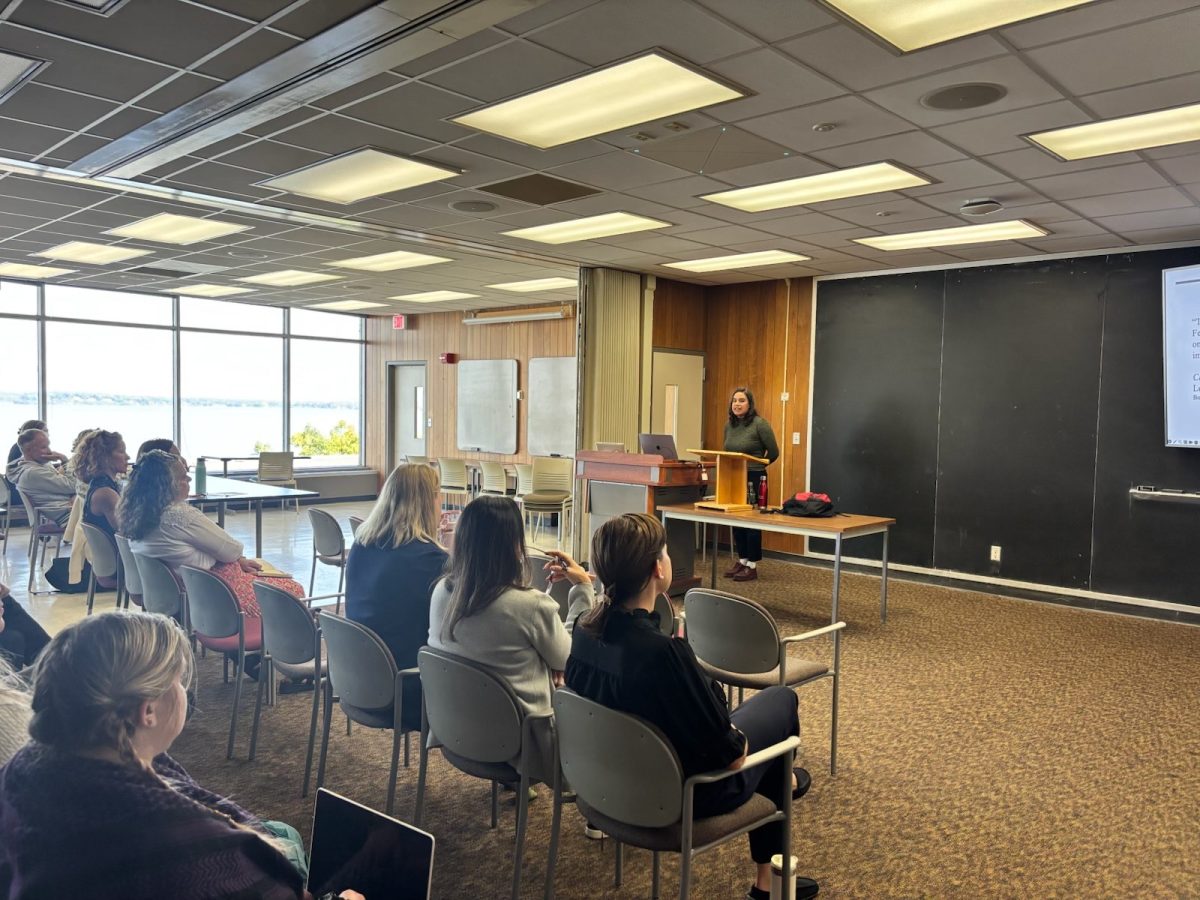

More than 50 people gathered on Thursday afternoon in William H. Sewell Social Sciences Building to listen to University of Wisconsin assistant professor of sociology Michaela Simmons discuss her research on the history of overrepresentation of Black children in foster care and how Child Protective Services became a tool of racial punishment from the 1930s onward.
Simmons gave the presentation as a part of UW Institute for Research on Poverty’s annual seminar, which hosts weekly events through December and is free and open to the public.
The presentation began by outlining current rates of children of color in foster care in New York, which is where Simmons focused her research. The research builds on New York City Child Welfare and childcare agency records between the 1930-1960s.
Black and Latine children account for 90% of the foster care system, despite representing approximately 60% of the total child population right now, according to Simmons.
“Scholars and activists like Dorothy Roberts have drawn parallels between the criminal justice system, employment and child welfare,” Simmons said. “In this context, it’s kind of hard to imagine a time when CPS wasn’t so ingrained in the lives of minorities, but we know from our research and history that Black children were not always overrepresented in the system.”
Child protection was initially developed for white immigrant children during the “New” Immigration Era, and remained a predominantly white system until the last century, according to Simmons.
Research tends to point to either the contemporary punitive swing in social policy, such as the carceral state, or from backlash to welfare access for nonwhite individuals in the 1960s as the impetus of foster care shifting to majority children of color, according to Simmons.
Simmons presented her postulation on why the racial composition of foster care changed compared with the research she conducted, which draws on the analogy of the foster care system and the carceral system as forms of racial punishment.
“Not only did Black families not reap the benefits of the child welfare shift towards family security — the local solutions devised to deal with Black child poverty created a dangerous and obscured relationship between foster care and the gendered labor market of the urban north,” Simmons said.
Historically, white women sought out foster care for their children with the hope of alleviating gender-based inequalities, such as marital abuse or lack of autonomy, according to Simmons’ research.
Black women approached foster care for reasons less to do with marital dysfunction, and more to do with poverty and exploitation in the labor market according to Simmons.
“Simply put, what I find is that Black women began fostering their children in order to work, and they worked so that they could be mothers,” Simmons said.
IRP will host a new speakers every Thursday in William H. Sewell Science Building Room 8147 or online until Dec. 4. The schedule is listed on their website.

