

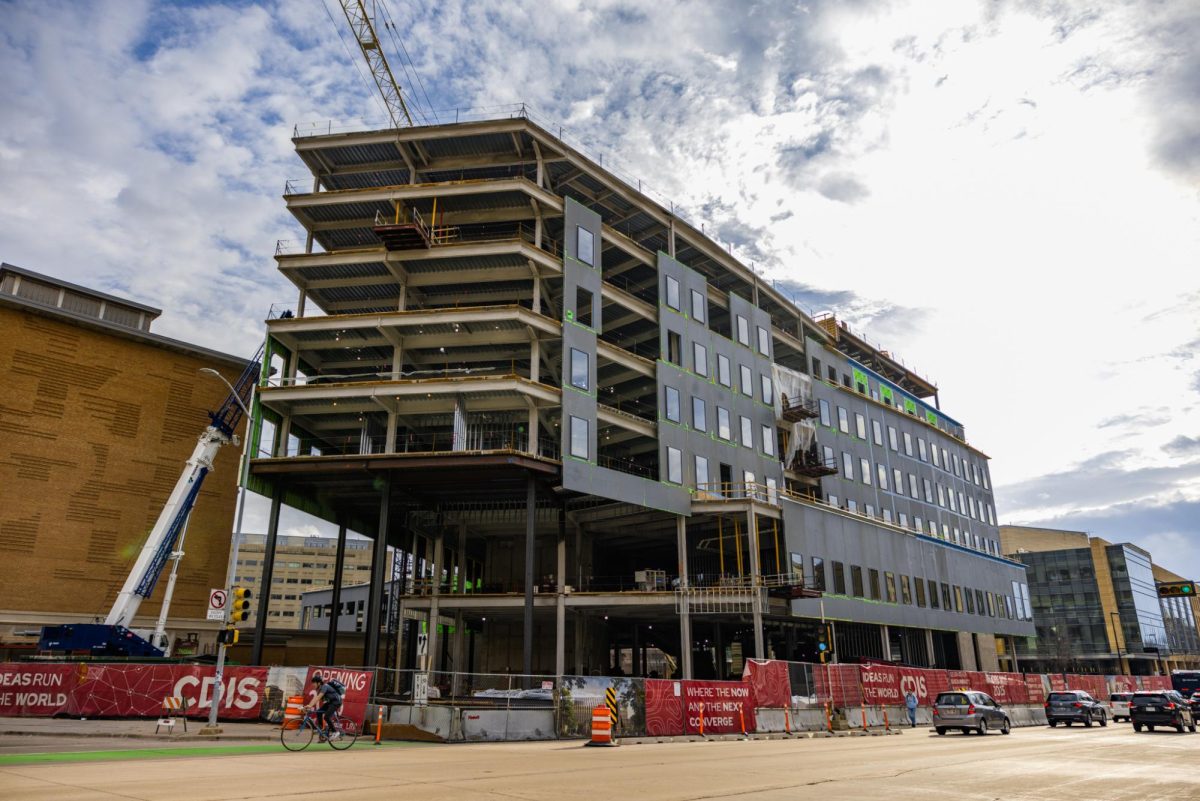

Morgridge Hall opened to thousands of University of Wisconsin students on the first day of class Sept. 3. The building’s opening marked the beginning of a new collaborative era between a series of educational departments at UW.
Morgridge Hall is home to the School of Computer, Data & Information Sciences. The departments within this school include computer sciences, statistics and information sciences alongside biostatistics and medical informatics. Additionally, it houses the Data Science Institute and the Center for High Throughput Computing.
Walking into the building on the first Friday of the school year, there were students in a variety of different study areas. While some students worked quietly in study nooks, others discussed new materials in the Phill and Liz Gross Learning Center with peer mentors.
Morgridge Hall is full of spaces for students to collaborate with their peers and professors, with intentions to make education more inviting. To pay homage to the first line of code that many new coders write, a conference room has been dubbed the “Hello World” room. From numerous study rooms to a roof top deck, the eight story building gives students plenty of space to work.
The goal of Morgridge Hall is not just to promote classroom learning. With additional space compared to the older computer science building, more interdisciplinary research is possible. It also facilitates the growth these departments have seen, according to Teaching Faculty I Bi Cheng Wu of the Department of Statistics.
“In [Morgridge Hall], a bunch of departments like statistics, comp sci., and the I School … are going to be in the same space,” Wu said. “It will open new avenues for collaboration and will invite more people to work together in this collaborative space.”
CDIS leadership has a responsibility to create programs and activities relating to their area of study, according to professor and department chair of the computer sciences department Paul Barford.
In 2024, Nobel prizes awarded in the fields of physics and chemistry were given to projects utilizing computational means. These awards highlight science is utilizing computational applications’ importance and interdisciplinary reach.
With science experiencing increased computational application, the Computer Science department wants to aid other departments at UW with computational based research, according to Barford.
“We’d love to facilitate groundbreaking work [that is primary computational] in many different disciplines,” Barford said. “We need to understand the needs of other departments and colleges on campus so that we can create capabilities and infrastructure that … they can have available to them.”
The new facility, and its staff, is obligated to foster groundbreaking discovery and innovation, according to Barford.
Focusing on research and innovation can also allow UW to make strides for everyone in Wisconsin topics like AI, according to Barford.
UW is focusing on AI as it becomes more prevalent in day to day life.
As majors within CDIS continue to expand, Morgridge Hall helps to facilitate more students and staff, according to Wu.
“These days data and AI are very popular topics,” Wu said. “We are always hearing about them in the news and media. Everyone sees this as an area for more growth and opportunities.”
The new building offers more opportunities for collaboration to advance topics like AI, according to Barford.
To give back to the community, the CDIS school wants to take research being done on campus and make it publicly accessible to students and the rest of the state, according to Barford.
“[This can be done] by transforming research into patents that the university can license,” Barford said. “Creating software that we make publicly available. [And] by interacting with individual companies in the state and beyond.”
This program aims to support students to work through the process of completing research projects.
Additionally, faculty are working on a new entrepreneurial program to help students at CDIS get involved in research and outreach, according to Barford.
“To support students who have the grit and willingness to do the hard work to turn ideas into products, we are planning on creating a series of programs and mechanisms to help move students through the process,” Barford said.
Morgridge Hall is a gathering spot. It will allow education, research and outreach for not just the majors housed in it, but all scientific disciplines across campus to advance, according to Barford.
The future of computing, statistics, and data science at UW will be in Morgridge Hall.
The opening of Morgridge Hall bears a promise that faculty will create an environment that maximizes educational opportunities for students, according to Barford.
“It’s great to see all the students in the building,” Barford said. “It’s now my responsibility to realize that promise.”