


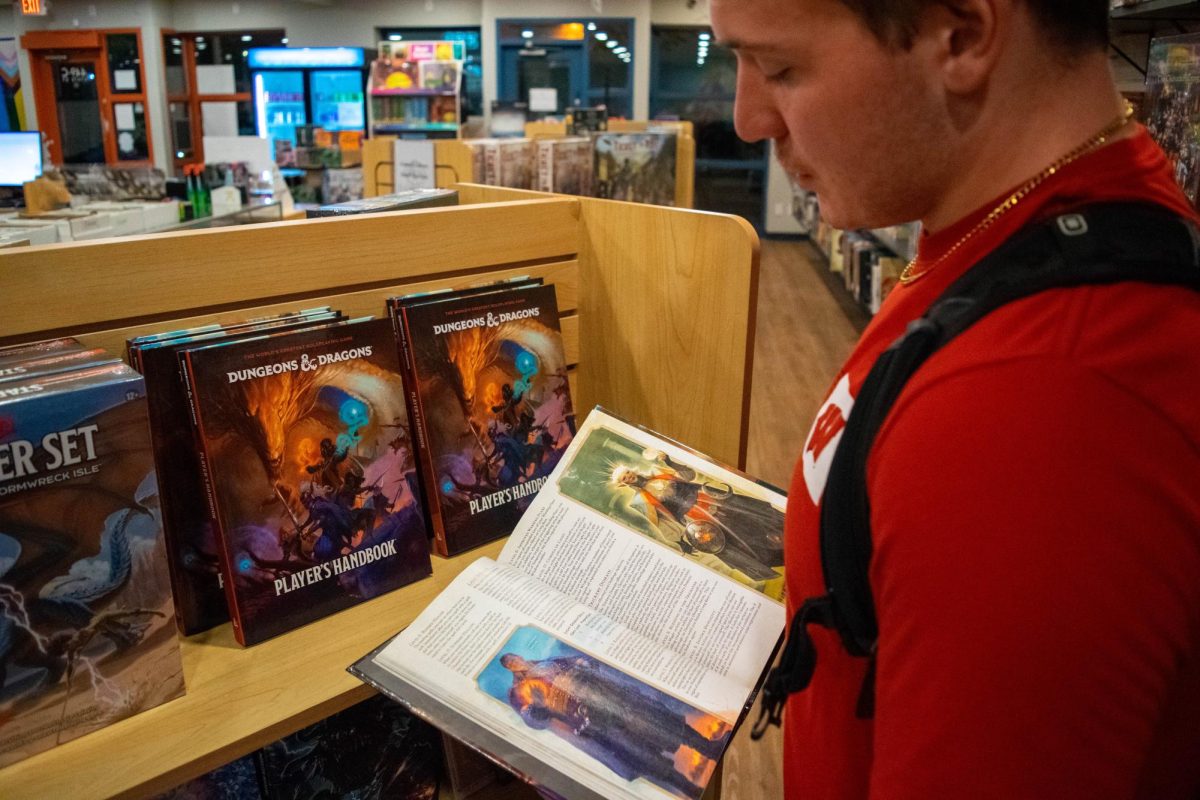

Jeremy Crawford, Lead Designer of Dungeons & Dragons Fifth Edition, and Chris Perkins, Creative Director of the game, announced they intend to leave Wizards of the Coast, D&D’s parent company, later this month, according to an article from D&D newsletter Bell of Lost Souls.
Crawford and Perkins have frequently appeared on live streams, Q&A panels, conventions and more, according to Bell of Lost Souls. Crawford especially has acted as an arbiter of D&D’s rules. The two are partially responsible for the game’s rise in popularity. This is in large part due to their transparency, frequent communication with fans and well-received work.
The Badger Herald spoke to two long-time followers of Dungeons and Dragons and roleplaying games about the potential implications of these departures.
Kalin Ahmad, a senior at the University of Wisconsin majoring in physics and philosophy, said he first started playing Dungeons & Dragons at age six with his family. Though he has since branched out into other roleplaying games, he still plays D&D somewhat frequently, he said.
Ahmad said he was not deeply familiar with Crawford or Perkins, though he thought their departures could signal a negative shift in the inner workings of WOTC. Even in a worst-case scenario, however, the situation does not necessarily suggest a massive decline in the game, he said.
“I don’t think it’s going to mean an end for D&D as a game or the tabletop roleplaying game scene,” Ahmad said.
The Badger Herald also spoke with Joe Alfano, a lifelong Madison local and D&D host who has played every edition of D&D over its 50-year lifespan. Many of his peers have been concerned by the recent departures of Crawford and Perkins, who have contributed greatly to the game over the years, Alfano said. Their retirements also raise questions about future changes to D&D, particularly as the roleplaying game industry is impacted by recent tariffs.
Despite these concerns, some players’ anxieties are reactionary and that Crawford and Perkins’ departures could be unrelated to the state of WOTC or D&D, Alfano said.
“Their motivations are their own,” Alfano said.
Some players perceive these departures as emblematic of a more business-focused viewpoint on D&D, Ahmad said. There are a multitude of recent controversies facing WOTC which are partially rooted in the games’ success over the past decade and an increased prioritization of the game making a profit.
Players who may be disillusioned with the current state of D&D can use their own content — also known as “homebrewed” content — or experiment with other roleplaying games, Ahmad said. The rules of D&D have existed long enough for players to meaningfully innovate on their own.
“People are going to go ahead and try to diversify [the game] into forms that fit their group,” Ahmad said.
Despite the potentially negative trends facing the industry, both Ahmad and Alfano remained optimistic about D&D’s future.
D&D has survived multiple periods where players assumed the game would lose influence or popularity, and remains very popular within Madison and the world as a whole, Alfano said.
According to Ahmad and Alfano, players can refer to D&D’s previous manuals or utilize their own creativity to continue to play the game. D&D’s longevity is linked just as much to player engagement as it is to industry or corporate changes.
“We can [host D&D] for our community … it’s our world … we can do whatever we want and [D&D] will continue on,” Alfano said.
It is doubtful D&D will go bankrupt or otherwise lose relevance, but even in the worst-case scenario, players will continue playing with one another. Though many concerns within the community are valid, the plethora of roleplaying game options will keep the fanbase alive.
Lastly, The Badger Herald spoke to Ahmad and Alfano about their favorite experiences with roleplaying games and why people should try the genre.
One of Ahmad’s favorite experiences with roleplaying games occurred recently while he was hosting a game of Lancer, a science-fiction focused roleplaying game, he said. A simple mission snowballed into a series of cataclysmic events that were completely unpredictable from the outset.
Ahmad particularly enjoyed seeing the players’ reactions to these sudden changes, and how the characters and storylines developed over multiple play sessions, he said. In this regard, roleplaying games can be both meaningful storytelling experiences and an enjoyable means of bonding with friends.
“Role playing games are just as much a way to hang out with your friends as it is to experience cool stories,” Ahmad said.
For Alfano, the community behind role playing games is the most important part of the experience. Alfano’s father was a community organizer, which helped him run D&D and other games and form tight-knit groups of players.
Alfano has seen players engage with D&D until they were physically no longer able to, and his favorite memories associated with the game are ones in which every participant was fully engaged, he said. D&D and other roleplaying games have a sense of camaraderie that is difficult to match.
“We’ve got that language that we all speak together,” Alfano said.

