


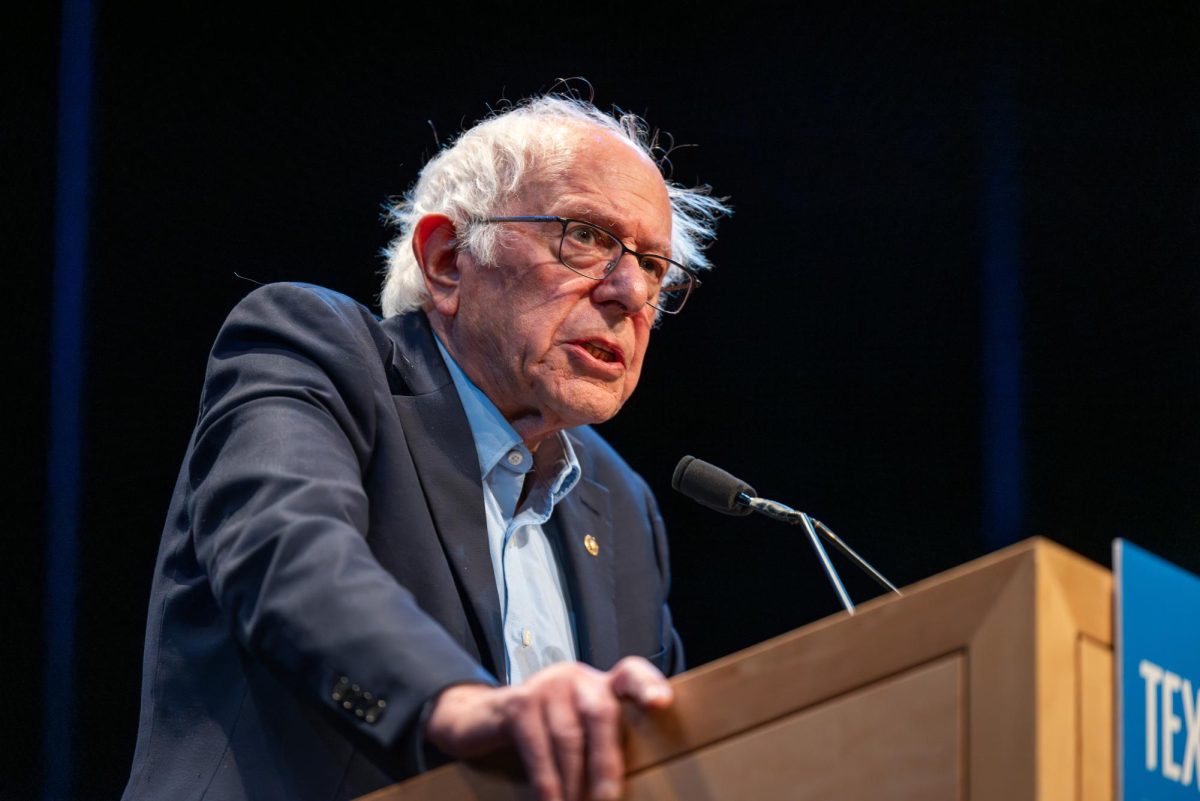

During the first weekend of Coachella, an unexpected guest made an appearance onstage. It was not a musician or performer, but rather Vermont Sen. Bernie Sanders, who took the stage to introduce Clairo, a pop singer-songwriter.
Before the introduction, Sanders took the opportunity to share a speech about the many political issues facing the United States, where he emphasized the importance of youth involvement in politics, according to CBS News.
Sanders was introduced by Maxwell Frost, who made history as the first Generation Z member of U.S. Congress when he was elected to represent Florida’s 10th congressional district at age 25. It was ironic that an 83-year-old senator took the stage at one of the largest and most culturally significant music festivals in the U.S., but the moment reflects both a symbolic passing of the torch to the younger generation of progressive leaders as well as a genuine plea to the youth of the U.S. to protect the rights and freedoms he and other left-leaning leaders of his generation fought to create.
According to The Sanders Institute, Sanders’ fight for progressive values began during his college years at the University of Chicago, where he was a champion of civil rights activism. He organized a sit-in in the university president’s office against housing segregation and was greatly influenced by his experiences in the Chicago community.
He also attended the 1963 March on Washington and witnessed Martin Luther King’s “I Have a Dream” speech. With values of community and justice instilled in him during his young adult years, Sanders approached his political career from the outside and has established himself as a central progressive leader.
In the first few months of Trump’s second term, voters have expressed frustration with rising prices and the elimination of social services, but Democratic leadership has been unable to form a timely, unified message against Trump’s abrasive actions, according to NPR.
Despite this, Sanders and New York Rep. Alexandria Ocasio-Cortez, who represents a generational shift in leadership, have begun a tour of “Fighting Oligarchy” rallies across the western United States to empower local action, according to The Hill. Their LA rally drew 36,000 people and was the largest event of either politician’s career.
The tour has echoed Sanders’ longstanding message of taking on racial and economic inequality while focusing on how young Americans can reject Trump’s influence. Sanders has clearly articulated these feelings and the gravity of the situation by taking to social media to try and stir youth action.
Sanders’ call to action cannot be ignored, especially while the Trump administration’s actions are directly impacting college students. Between large funding cuts for research, anti-DEI policies and anti-immigrant raids, Trump’s actions threaten the prestige of American higher education institutions, according to Inside Higher Ed. More importantly, they create a state of uncertainty about the support necessary for many programs to continue without pandering to the administration’s agenda.
Gen-Z has often been in the spotlight for teenage activism, including protests against gun violence and climate change, which gained momentum during Trump’s first term. Additionally, online anti-Trump activism in 2020 assisted Biden’s victory, and many of these same individuals continued work in student organizations and during the Harris campaign.
After nearly a decade of Trump’s leadership and campaigns, many young people report feeling fatigued and unsatisfied with the American political system, according to UC Berkeley Research.
Social movements were critical in highlighting the extreme discontent with Trump’s governance during his first term, spanning from the 2017 Women’s March to the 2020 Black Lives Matter movement. The Conversation states that while these mass movements may not directly influence Republicans in Washington, they have a greater influence over businesses, lower courts and local politics.
Thus, organizing or attending a protest may be a way for young people to channel a broader anger over Trump’s policies into a community-building and potentially hopeful event. Small steps to spread awareness range from calling members of Congress to express opinions on new bills to joining local political groups to engage with like-minded leaders on campus or in the community. These are all ways to familiarize oneself with democratic processes and get more involved in the political landscape.
Intentional spending can also be largely influential, and individuals can research the donation history of brands and their response to Trump’s DEI policies and choose to boycott those businesses. Getting involved in volunteer organizations and working to eliminate inequalities, such as food insecurity or illiteracy, is also a great way to help the many marginalized communities that the administration has threatened.
The basis of this action is an understanding of the policies taking place, so the most important aspect of resisting Trump is to continue to educate oneself on issues while avoiding burnout because of Trump’s overwhelming actions. Additionally, verifying news and information seen on social media before sharing it helps counter fear-mongering and disinformation.
In general, pessimism about the future of the country will not improve its situation, so those who were dissatisfied with the response to past protests cannot fully disengage from politics and instead should work to develop other ways of pushing back. If young people remain complicit in this moment, it sets a precedent that leaders can bully a population into accepting their terms. This challenging moment requires younger, progressive leadership and action. Leaders such as Ocasio-Cortez and Frost cannot obtain influence in the larger Democratic party without the visible mobilization of young people.
Ultimately, there is no alternative to taking action, as failing to do so will allow the nation to spiral into oligarchy. Young people must remain educated and engaged in the fight against the destruction of the foundations of democracy through action within a local community. As Sanders explained from the Coachella stage, “the future of what happens to America is dependent upon your generation.”

